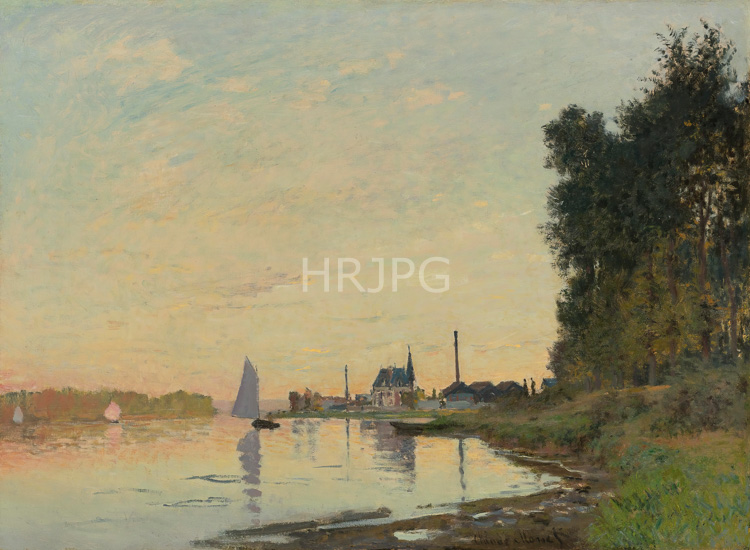
The visual logic of the painting is defined by the extraordinary contrast between the dark, silhouetted forms of the trees and the brilliant, golden light of the sky. Monet utilizes a palette dominated by warm ochres, fiery oranges, and deep violet shadows to represent the sunset 'envelope.' The river in the foreground is a liquid mirror, rendered with horizontal, rhythmic brushstrokes that capture the flickering reflections of the sun and the distant buildings. He avoids hard outlines entirely, relying instead on the vibration of color to define form and depth. This focus on the dissolution of solid objects under the influence of light was the ultimate goal of his mid-career practice. The light is the primary actor, transforming the water into a shimmering field of fire that makes the atmosphere feel as physical as the water itself.
Technically, The Seine at Petit-Gennevilliers Sunset showcases Monet’s mastery of 'all-over' texture and chromatic vibration. He applied the paint in thick, rhythmic layers of impasto, giving the surface a physical presence of its own. He avoids the use of black, using deep indigos and saturated purples in the shadows to maintain the painting's overall luminosity. Historically, the works of 1874 reflect the professional commitment and shared vision of the Impressionist group during their first exhibition. Today, held in major collections such as the Musée d'Orsay and the Art Institute of Chicago, the painting is admired for its raw power and its visionary spirit. It remains a cornerstone of modern art, illustrating the moment when the landscape became a vehicle for the exploration of pure light and emotion.