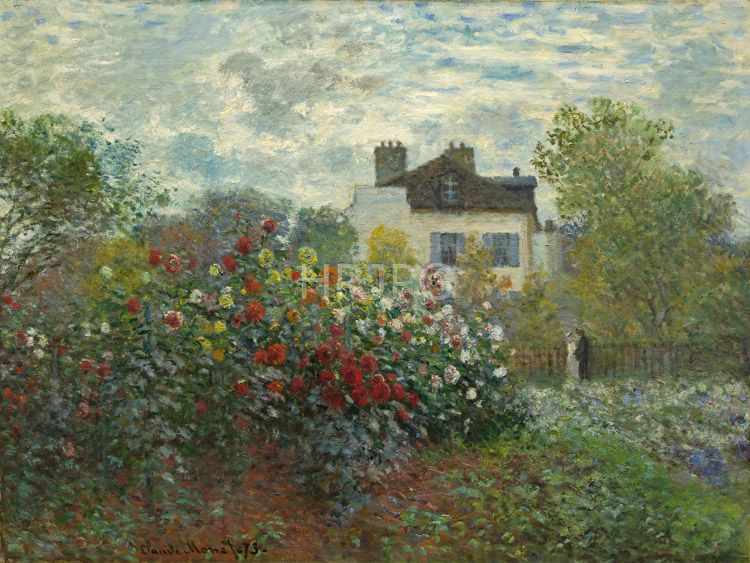
The visual logic of the painting is defined by the extraordinary play of sunlight filtering through the trees and illuminating the garden. Monet utilizes a palette of vibrant reds, deep emeralds, and brilliant whites to represent the summer 'envelope.' The path in the center provides a strong diagonal that leads the eye toward the figure of Jean, while the flowerbeds provide a rhythmic vertical accent that anchors the composition. The light is the primary actor, raking across the gravel and illuminating the white petals of the flowers with a natural clarity. The shadows are rendered in deep purples and blues rather than traditional black, maintaining a consistent luminosity throughout. This chromatic approach gives the entire scene a vibrating, lifelike quality that mimics the actual experience of human vision on a warm afternoon.
Technically, The Artist's Garden in Argenteuil showcases Monet’s early mastery of 'broken color' and gestural application. The brushwork is exceptionally free and spontaneous, reflecting the speed required to capture the shifting patterns of light. He avoids hard outlines, allowing the atmosphere to blur the boundaries between the figure and the garden, creating a unified and immersive environment. Historically, the Argenteuil paintings reflect the post-war prosperity and the emergence of the middle-class garden as a primary site of modern leisure. Today, held in major collections such as the Art Institute of Chicago and the Musée d'Orsay, the painting is admired for its formal strength and its evocative mood. It serves as a vital document of Monet's creative process and his deep emotional connection to his family.