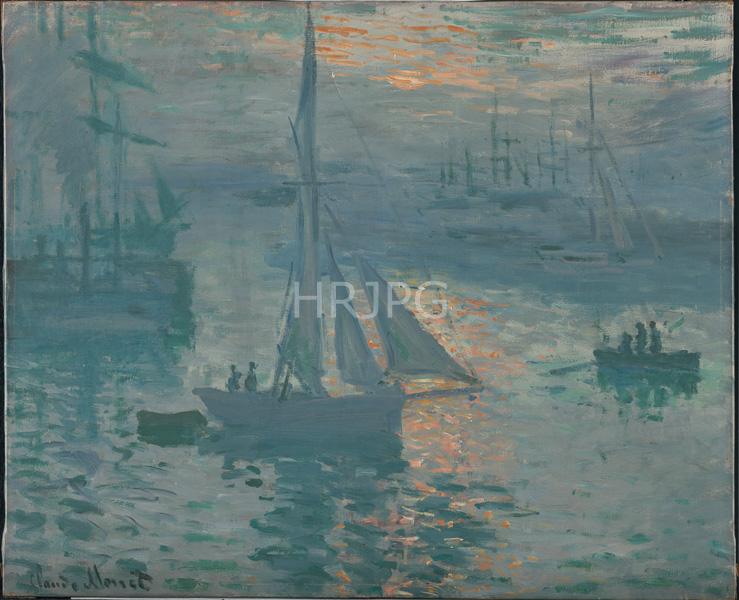
The visual logic of the painting is defined by the extraordinary contrast between the cool, murky blues of the harbor and the brilliant, fiery orange of the rising sun. Monet utilizes a sophisticated palette of deep indigos, soft lavenders, and vibrant ochres to represent the moisture-laden atmosphere. The sun, appearing as a concentrated disk of light, reflects across the water in a series of horizontal, rhythmic brushstrokes that capture the flickering energy of the dawn. The industrial silhouettes of the cranes and ships in the background are rendered as ghostly, simplified forms that provide a strong structural framework for the composition. He avoids hard outlines entirely, relying instead on the vibration of color to define form and depth, making the air feel as physical as the water and the stone.
Technically, Sunrise: The Sea showcases Monet’s mastery of 'broken color' and gestural application. The brushwork is exceptionally free and spontaneous, reflecting the speed required to capture the shifting patterns of light. He avoids the use of black entirely, using deep blues and purples in the shadows to maintain the painting's overall luminosity. Historically, this work was a major professional achievement, proving that the Impressionist method could handle subjects of monumental beauty with a revolutionary eye. Today, held in the collection of the Musée Marmottan Monet, the painting remains a universal symbol of the beauty of nature and the power of the human eye. It serves as a vital document of Monet's creative process, illustrating the birth of modern art and the endless possibilities of light.