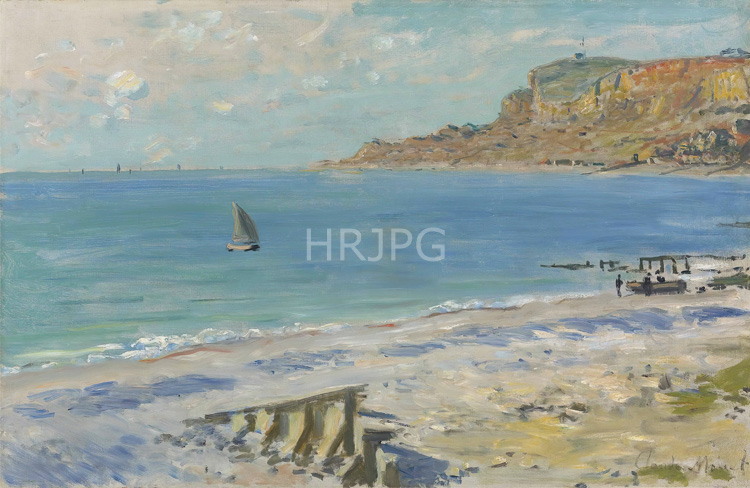
The visual logic of the painting is defined by the extraordinary clarity and vibrancy of the natural light. Monet utilizes a lush and saturated palette to represent the coastal atmosphere. The expansive sandy beach in the foreground is rendered with short, rhythmic, and textural brushstrokes of warm ochres and pale yellows, creating a shimmering field that seems to vibrate with heat. Beyond the shore, the brilliant blue of the English Channel is a masterclass in capturing moving water; Monet uses horizontal slashes of varied blues—from deep indigo to pale cerulean—and bursts of pure white to suggest the flickering reflections of the sky and the sea spray. A single sailboat, with its elegant white sail catching the sun, provides a powerful vertical anchor that cuts across the horizontal expanse of the river, while smaller vessels on the distant horizon add depth and narrative structure.
Technically, Sailing At Sainte Adresse showcases Monet’s move toward a more gestural and 'all-over' application of paint. He applied the paint in thick, vibrating layers of impasto, giving the surface a physical presence that mirrors the tactile quality of the sand and the water. The brushwork is exceptionally free and spontaneous, reflecting the speed required to capture the precise 'instantaneity' of the light before it shifted. He avoids traditional hard lines and boundaries, allowing the atmosphere to blur the edges between the land, sea, and sky, creating a unified and immersive field of perception. He rejects the use of flat black, using deep indigos and cool purples in the shadows to maintain the painting's overall luminosity despite the shaded areas.
Historically, this work reflects the stability and peace Monet found in the Normandy coast during a time of great personal and professional change. It is part of a series (alongside works like 'Regattas at Sainte-Adresse') that sought to explore how a single location could be transformed by shifting weather and time. Today, held in major collections such as the National Gallery of Art in Washington, D.C., the painting is admired for its formal strength and its pioneering spirit. It serves as a vital document of Monet's creative process, illustrating the perfect union between his revolutionary eye and the natural world he sought to record with such honesty and passion, forever capturing the essence of the French coast as a theater of pure light."