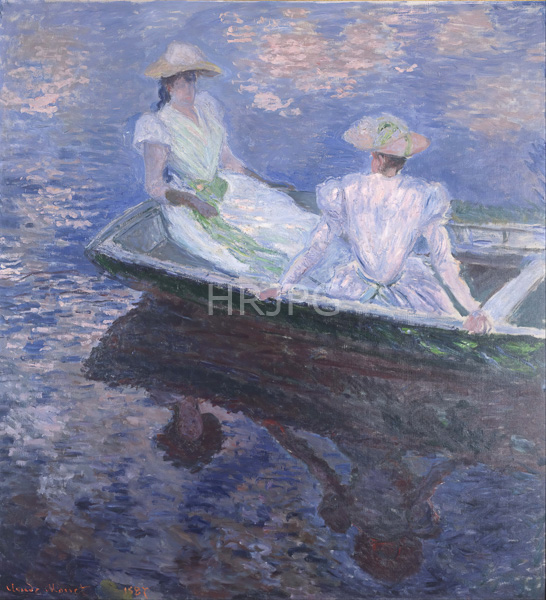
The visual logic of the painting is defined by the high-angled perspective and the extraordinary symmetry between the boat and its reflection. Monet utilizes a sophisticated palette of cool greens, soft purples, and muted ochres to represent the atmospheric effect. The boat, with its elegant wooden hull, provides a strong structural framework that anchors the composition. The women are rendered with a characteristic Impressionist shorthand, their forms integrated into the environment through the play of light and shadow. The water in the foreground is a liquid mirror, reflecting the lush greenery of the surrounding trees and the soft light of the sky. This 'mirror effect' creates a sense of profound stillness and natural order, reflecting Monet’s interest in the decorative patterns and flattened space of Japanese aesthetics. There is no central focal point; the eye is encouraged to wander through the depth of the reflections.
Technically, On the Boat showcases Monet’s mastery of 'all-over' texture and the rejection of traditional perspective. He used a confident application of paint to build up the surface of the boat and the foliage, giving the scene a tangible presence. He avoids the use of black, using deep blues and purples in the shadows to maintain the painting's overall luminosity. Historically, these river works represent a critical step in Monet’s evolution toward a more abstract and contemplative style. Today, held in major collections such as the Musée d'Orsay, the painting is admired for its lyrical beauty and its technical virtuosity. It remains a vital document of his Giverny years, illustrating the perfect union between his revolutionary eye and the world of light and reflection.