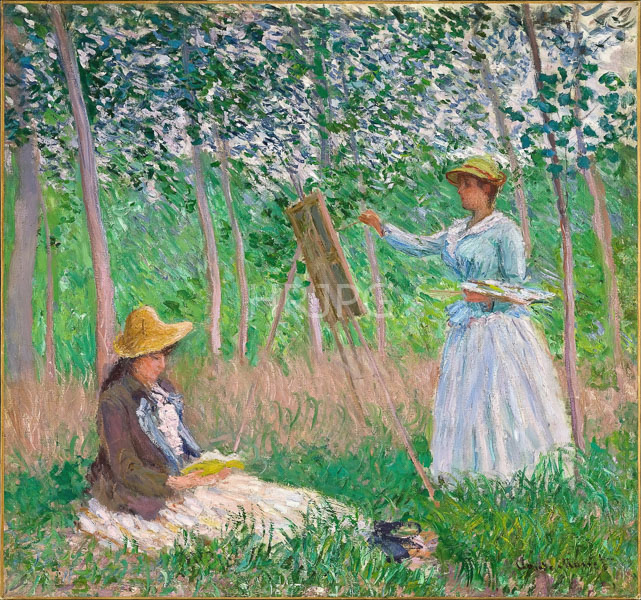
The visual logic of the painting is defined by the extraordinary play of sunlight filtering through the dense canopy of trees. Monet utilizes a palette of vibrant greens, soft ochres, and brilliant whites to represent the summer light. The trees provide a rhythmic vertical framework that anchors the composition, creating a sense of depth and spatial order. Blanche is depicted with a characteristic Impressionist shorthand, her light-colored dress catching the brilliance of the sun and creating a shimmering 'envelope' of air. He avoids hard outlines, relying instead on the juxtaposition of tonal values to define form and space. The sunlight filters through the leaves, creating a complex pattern of highlights across her dress and the forest floor. The shadows are rendered in cool purples and blues rather than traditional black, maintaining a consistent luminosity throughout the composition.
Technically, In the Woods at Giverny showcases Monet’s mastery of 'broken color' and gestural application. The brushwork is exceptionally free and spontaneous, reflecting the speed required to capture the shifting patterns of light and the movement of the breeze in the leaves. He avoids the use of black entirely, using deep blues and purples in the shadows to maintain the painting's overall luminosity. Historically, the garden and woods paintings of the late 1880s reflect the stability and peace Monet found in Giverny after decades of struggle. Today, held in major collections such as the Los Angeles County Museum of Art and the Musée d'Orsay, the painting is admired for its formal strength and its evocative mood. It serves as a vital document of Monet's creative process, illustrating the bridge between his early realism and the atmospheric investigations of his mature style.