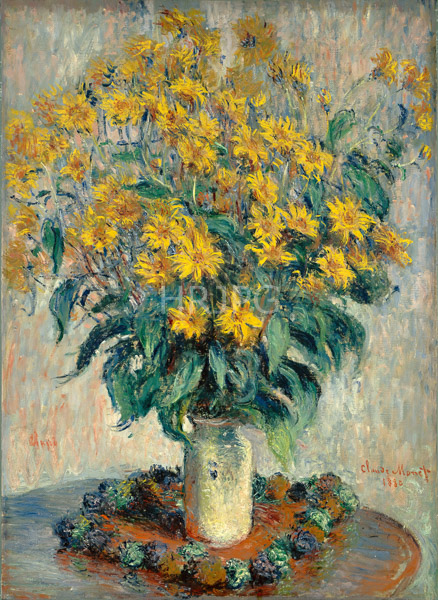
The visual center of the painting is the extraordinary explosion of yellow blossoms, which Monet renders with a tactile weight and rhythmic energy. He utilizes a palette of brilliant yellows, warm ochres, and deep greens, all set against a neutral, atmospheric background that pushes the flowers directly toward the viewer. The light filters from an unseen source, raking across the petals to create a complex pattern of highlights and shadows. He avoids hard outlines, relying instead on the vibration of color against color to define the form of each bloom. This focus on the sensory 'impression' of the scene—capturing the vibrancy of the flowers before they withered—was a radical innovation in still-life painting. The bouquet is treated not as a botanical record, but as a shimmering field of color and light that unified the domestic space.
Technically, Jerusalem Artichoke Flowers showcases Monet’s mastery of 'broken color' and gestural application. The brushwork is exceptionally free and spontaneous, reflecting the speed required to capture the shifting patterns of light. He avoids the use of black entirely, using deep blues and purples in the shadows to maintain the painting's overall luminosity. Historically, this work reflects the stability and peace Monet sought in Vétheuil after a period of deep personal tragedy. Today, held in major collections such as the National Gallery of Art and the Musée d'Orsay, the painting is admired for its freshness and its lyrical beauty. It serves as a vital document of Monet's creative process, illustrating the bridge between his early outdoor observations and the visionary landscapes of his later years, reminding us that for him, the world was a continuous symphony of light and color.