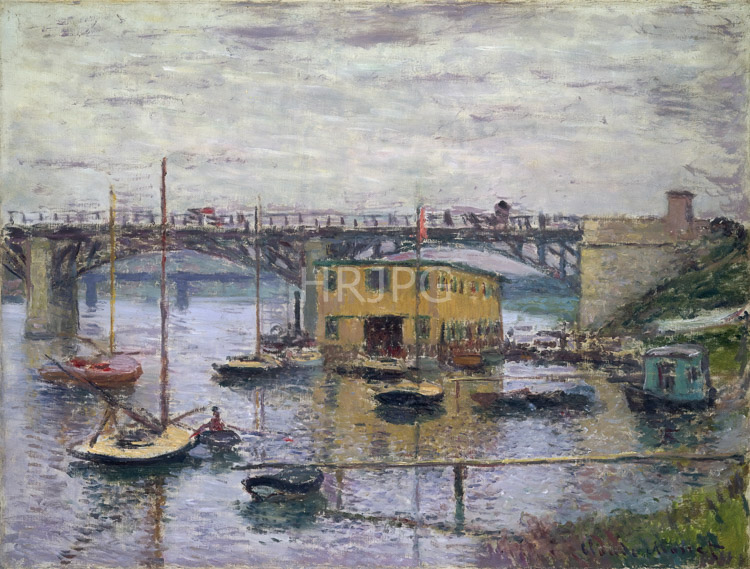
The visual logic of the painting is defined by the extraordinary tonal harmony between the bridge, the water, and the sky. Monet utilizes a restricted and sophisticated palette of leaden grays, murky indigos, and muted ochres to represent the industrial 'envelope.' The bridge provides a strong structural framework for the composition, its dark silhouette providing a counterpoint to the horizontal expanse of the river. The water in the foreground is rendered with horizontal, rhythmic brushstrokes that capture the flickering reflections of the sky and the houses. He avoids hard outlines, relying instead on the vibration of tonal values to define form and depth. The light is the primary actor, diffused and soft, creating a shimmering 'envelope' of air that makes the scene feel fresh and immediate despite the somber mood.
Technically, Bridge at Argenteuil on a Gray Day showcases Monet’s mastery of 'all-over' texture and his rejection of traditional perspective. He used a confident application of paint to build up the surface of the water and the stone, giving the scene a tangible presence. He avoids the use of black, using deep blues and purples in the shadows to maintain the painting's overall luminosity. Historically, the Argenteuil series was a critical success, proving that the Impressionist method was a universal language capable of handling even the most industrial of subjects. Today, held in major collections such as the National Gallery of Art and the Musée d'Orsay, the painting remains a vital document of the 19th-century avant-garde, illustrating the moment when art broke away from naturalism to embrace the dynamic, fragmented reality of the industrial age.