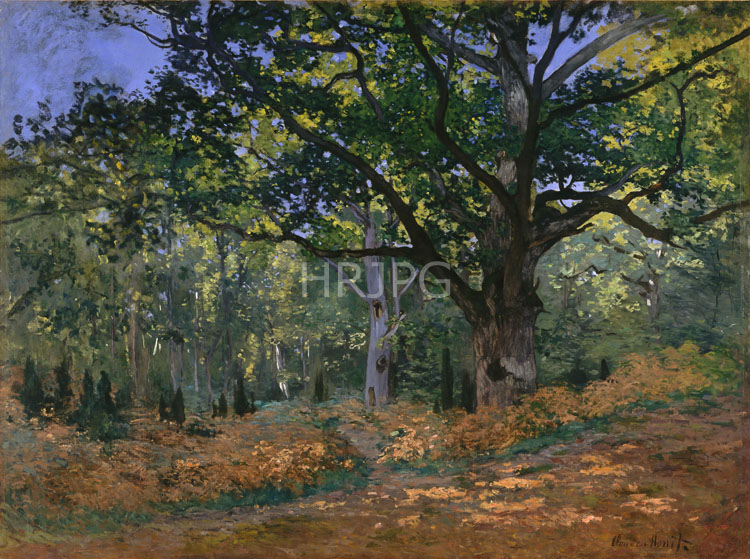
The visual logic of the painting is defined by the extraordinary mass of the oak and the play of sunlight filtering through its leaves. Monet utilizes a palette dominated by earthy browns, deep greens, and warm ochres to represent the forest light. The tree is rendered with a tactile weight, its bark captured in a play of light and shadow that suggests its physical presence and age. The forest floor is covered with fallen leaves, rendered with short, rhythmic brushstrokes that prefigure his later 'broken color' technique. He avoids the rigid finish of academic tradition, favoring a more textured application of paint that gives the scene a sense of presence and life. The light is the primary actor, raking across the trunk and illuminating the edges of the foliage with a natural clarity that makes the scene feel fresh and immediate.
Technically, The Bodmer Oak showcases Monet’s early mastery of chiaroscuro and tonal harmony. He used a confident application of paint to build up the surface of the tree and the earth, giving the landscape a tangible, sculptural presence. He avoids traditional black even in the deepest shadows, using deep blues and purples to maintain a consistent luminosity throughout. Historically, this work represents the foundation of Monet’s career and his lifelong connection to nature. It was part of the studies he made for his ambitious 'Le Déjeuner sur l'herbe.' Today, held in major collections such as the Metropolitan Museum of Art, the painting is admired for its formal strength and its pioneering spirit. It serves as a reminder that for Monet, the natural world was the ultimate teacher, and his journey toward light began with a rigorous observation of the ancient giants of the forest.