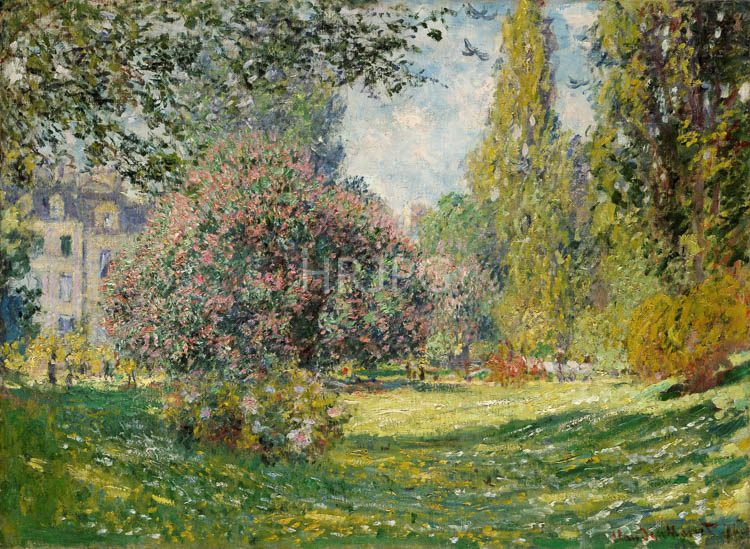
The visual logic of the painting is defined by the extraordinary play of dappled sunlight filtering through the ancient trees and illuminating the lush green lawn. Monet utilizes a palette dominated by vibrant emeralds, soft ochres, and brilliant whites to represent the summer 'envelope.' The fashionable figures provide a sense of scale and social reality, their light-colored garments catching the brilliance of the sun. The sky is only visible through the dense canopy, which creates a complex pattern of highlights across the ground. He avoids hard outlines, relying instead on the juxtaposition of tonal values to define form and depth. This chromatic approach gives the entire scene a vibrating, lifelike quality that mimics the actual experience of human vision on a warm afternoon. The park is treated not as a topographical record, but as a sensory impression of light and motion.
Technically, Park Monceau showcases Monet’s mastery of 'all-over' texture and the rejection of traditional perspective. He used a confident, impasto technique to build up the surface of the grass and the foliage, giving the scene a tangible presence. He avoids the use of black, using deep blues and purples in the shadows to maintain the painting's overall luminosity. Historically, this work reflects the stability and peace of the Third Republic and the emergence of the public park as a primary subject for modern art. Today, versions of this work are held in major collections such as the Metropolitan Museum of Art and the Musée d'Orsay. It remains a vital document of Monet's creative process, illustrating the moment when the city became a stage for a new visual language of light and atmosphere.