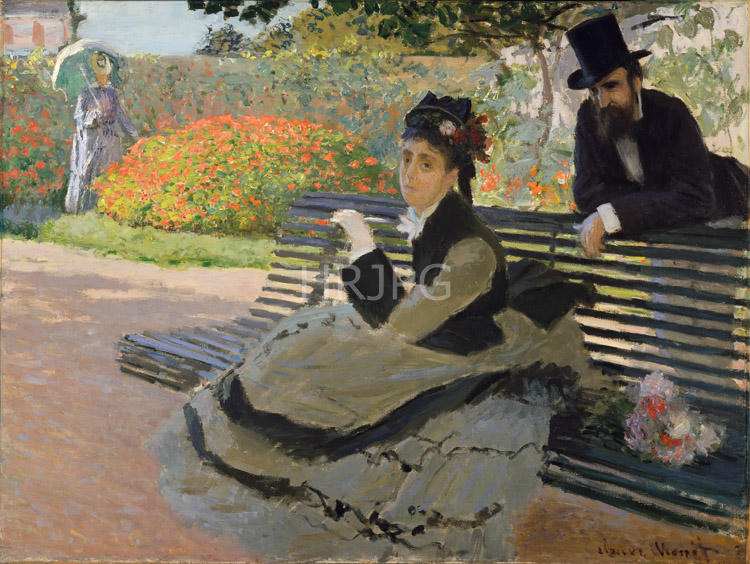
The visual logic of the painting is defined by the extraordinary play of dappled sunlight filtering through the trees and the contrast between light and shade. Monet utilizes a palette dominated by warm ochres, deep greens, and brilliant whites to represent the summer light. Camille is depicted in a fashionable black and white dress, which serves as a primary surface for the study of light and reflection. The sunlight filters through the leaves, creating a complex pattern of highlights across her dress and the garden bench. He avoids hard outlines, relying instead on the juxtaposition of tonal values to define form and space. The shadows are rendered in cool purples and blues rather than traditional black, maintaining a consistent luminosity throughout the composition. This chromatic approach gives the entire scene a vibrating, lifelike quality that mimics the actual experience of human vision.
Technically, Camille Monet on a Garden Bench showcases Monet’s early mastery of texture and tonal harmony. He used a confident application of paint to build up the surface of the dress and the foliage, giving the scene a tangible presence. He avoids the use of black, using deep blues in the shadows to maintain the painting's overall luminosity despite the shaded environment. Historically, this work reflects the stability and peace of Monet's early years in Argenteuil, reflecting a personal moment of peace amidst artistic struggle. Today, held in the collection of the Metropolitan Museum of Art, the painting is admired for its formal strength and its evocative mood. It remains a cornerstone of early Impressionism, illustrating the perfect union between the artist’s revolutionary eye and the private, intimate world of his family.