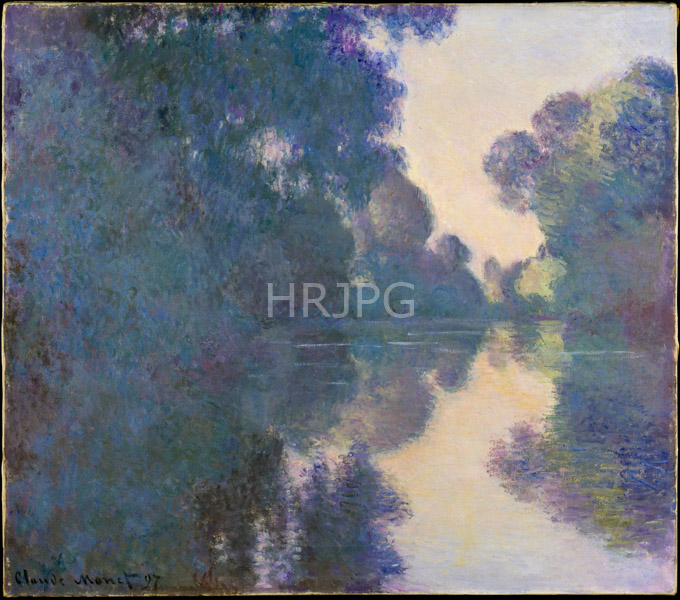
The visual logic of the painting is defined by its extraordinary symmetry and the near-total removal of the horizon line. Monet utilizes a sophisticated palette of pale lavenders, soft silvers, and muted greens to represent the moisture-laden morning air. The trees along the bank are rendered as rhythmic, vertical masses whose forms are mirrored perfectly in the calm, glass-like surface of the river. This 'mirror effect' creates a sense of infinite, weightless space where the sky and the water become indistinguishable. He avoids hard outlines entirely, relying on the vibration of color against color to define the boundaries of the land. The light is the primary actor, diffused through the mist and creating a shimmering, iridescent surface that suggests a state of eternal flux and natural harmony.
Technically, the Morning on the Seine series showcases Monet’s mastery of tonal unity and 'all-over' texture. He worked on multiple canvases simultaneously, moving between them as the light shifted every few minutes to capture the precise 'instantaneity' of the dawn. The brushwork is delicate and blended, capturing the tactile quality of the damp air and the transparency of the water. He avoids the use of black, using deep indigos and cool purples in the shadows to maintain the painting's overall luminosity. Historically, this series was a critical success, hailed as a supreme example of his ability to capture the 'invisible' air. Today, held in major collections such as the Musée d'Orsay and the Metropolitan Museum of Art, it remains a cornerstone of late Impressionism, illustrating the perfect union between the artist’s eye and the environment.