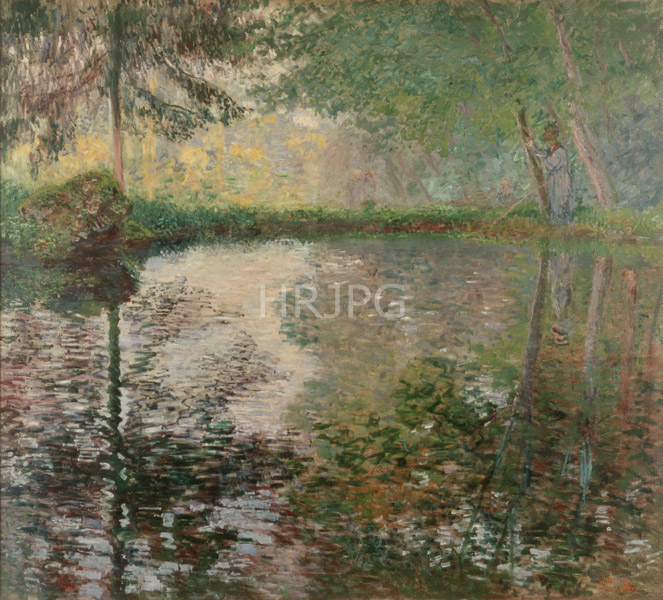
The visual center of the painting is the extraordinary play of sunlight filtering through the dense canopy of trees and illuminating the surface of the pond. Monet utilizes a palette of vibrant greens, deep emeralds, and brilliant whites to represent the summer light. The composition is immersive and dense, leading the viewer’s eye through the textures of the foliage and the colorful reflections. The light is the primary actor, raking across the water and creating a shimmering 'envelope' of warm air that unifies the environment. The shadows are rendered in deep purples and blues rather than traditional black, maintaining a consistent luminosity. This chromatic approach gives the entire scene a vibrating, lifelike quality that mimics the actual experience of human vision on a warm afternoon. The pond is treated not as a topographical record, but as a sensory impression of abundance and quiet beauty.
Technically, Pond at Montgeron showcases Monet’s mastery of 'all-over' texture and the rejection of traditional perspective. He used short, rhythmic brushstrokes for the foliage and more fluid strokes for the water, creating a textured surface that has a physical presence of its own. Historically, the Montgeron series was a significant project for Monet, demonstrating his ability to handle complex, large-scale decorative compositions. It reflects the prosperity of his early years and the emergence of the garden as a primary subject for modern art. Today, held in the collection of the Hermitage Museum, the painting is admired for its freshness and its pioneering spirit. It remains a cornerstone of mid-career Impressionism, illustrating the perfect union between the artist’s revolutionary eye and the natural world he sought to record with such honesty and passion.