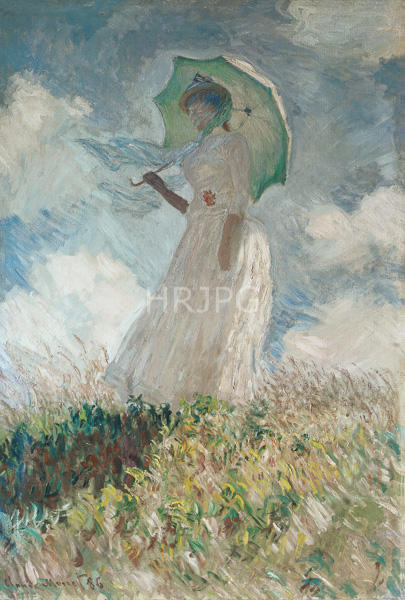
The visual impact of the painting is achieved through its extraordinary low-angled perspective, which pushes the figure toward the brilliant summer sky, turning her into a monument of light. Monet utilizes a palette of azure blues, brilliant whites, and lush emeralds to represent the summer 'envelope.' The figure of Suzanne, with her white dress and green parasol, catches the brilliance of the sun and echoes the movement of the scudding clouds above. The sunlight is the primary actor, raking across the meadow and illuminating the fabric of the dress with a natural clarity. The shadows across her face and the grass are rendered in cool purples and blues rather than traditional black, maintaining a consistent luminosity throughout. This chromatic approach gives the entire scene a vibrating, lifelike quality that mimics the actual experience of human vision on a breezy afternoon.
Technically, Woman with a Parasol Facing Left showcases Monet’s mastery of 'broken color' and gestural application. The brushwork is exceptionally free and spontaneous, reflecting the speed required to capture the shifting patterns of light and the wind in the grass. He avoids hard outlines, allowing the atmosphere to blur the boundaries between the figure and the sky, creating a unified and immersive environment. Historically, this work was a major success, proving that the Impressionist method could handle complex outdoor figure compositions with a revolutionary eye. Today, held in the collection of the Musée d'Orsay, the painting remains a universal symbol of the beauty of nature and the innocence of the present moment. It serves as a vital document of Monet's creative process, illustrating the perfect union between his revolutionary eye and the natural world he so passionately recorded.