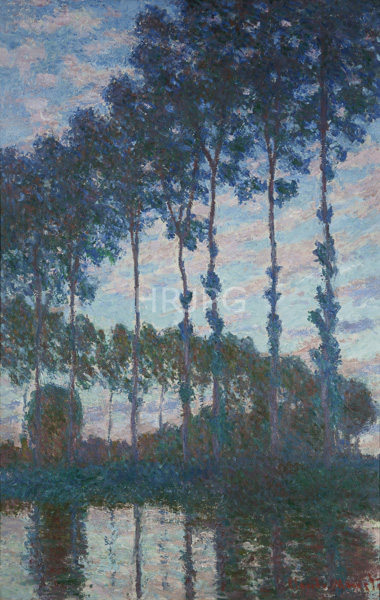
The visual logic of the painting is defined by the extraordinary S-curve of the riverbank and the towering verticality of the poplars. Monet utilizes a palette of soft greens, warm ochres, and pale blues to represent the atmospheric effect of a bright, breezy day. The trees are simplified into rhythmic, vertical accents that lead the viewer’s eye through the depth of the landscape, their forms mirrored in the calm surface of the Epte. This 'mirror effect' creates a sense of profound stillness and natural order, reflecting Monet’s interest in the decorative patterns and flattened space of Japanese prints. The sunlight is the primary actor, raking across the foliage and creating a shimmering 'envelope' of light that unifies the trees with the sky.
Technically, Poplars on the Banks of the Epte showcases Monet’s mastery of 'all-over' texture and the rejection of traditional perspective. He applied the paint in short, rhythmic dabs and more textured, impasto marks for the leaves, giving the foliage a tangible, sculptural quality. He avoids the use of black entirely, using deep indigos and cool greens in the shadows to maintain the painting's overall luminosity. Historically, the Poplar series was a critical success, proving that the Impressionist method could find monumental beauty in the simplest of patterns. Today, held in major collections such as the Philadelphia Museum of Art, the painting remains a beloved icon of modern art. It serves as a vital document of Monet's creative process, illustrating the bridge between his early outdoor observations and the visionary landscapes of his final years.