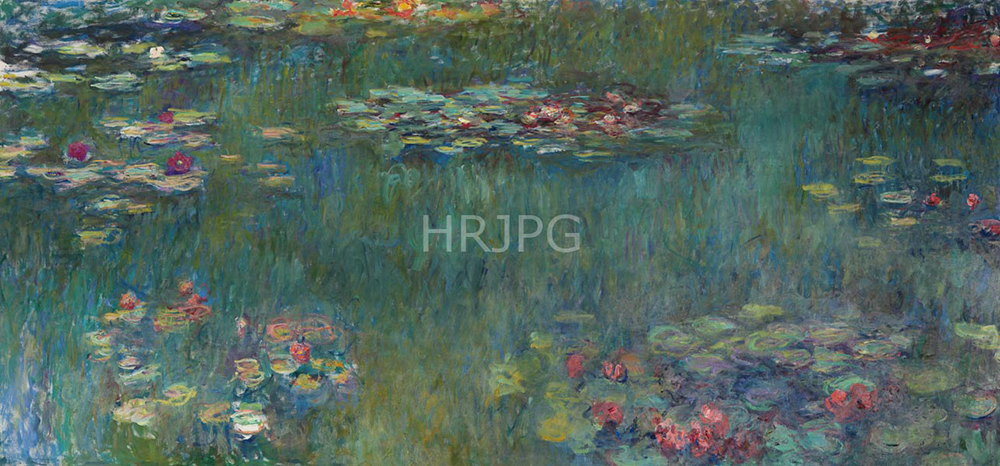
The visual logic of the painting is defined by its 'all-over' composition and the complete removal of any traditional horizon line or spatial anchors. The viewer is plunged directly into the liquid heart of the garden, where the surface of the pond acts as a visionary mirror for the sky and the surrounding weeping willows. Monet utilizes an intense and non-naturalistic palette of deep emeralds, vibrant purples, and fiery ochres, reflecting his internal sensory experience rather than a topographical record. The water lilies are treated as rhythmic islands of saturated color—reds and oranges—that seem to float within the sea of dense, vertical reflections. This layering of light and matter creates a sense of infinite space within a shallow, flat environment. The light is the primary actor, transforming the water into a shimmering field of energy that makes the atmosphere feel as tangible as the water lilies themselves. He avoids hard outlines entirely, relying on the vibration of color against color to define depth and motion.
Technically, the 1920 Pool with Waterlilies showcases Monet’s transition into a more intuitive, gestural, and memory-based painting process. He applied the paint in thick, rhythmic layers of impasto, using large brushes and energetic movements that give the surface a physical presence and a tactile quality. He avoids the use of black, using saturated indigos and violets in the shadows to maintain a high-keyed luminosity despite the somber and intense palette. The brushwork is exceptionally bold, with large, sweeping arcs and staccato dabs that suggest the rustling of leaves and the flickering of light on water. Historically, these late works were long misunderstood as the product of failing vision, but they are now recognized as pioneering masterpieces of modernism. Today, held in major collections such as the Musée d'Orsay and the Musée Marmottan Monet, the painting continues to inspire awe for its raw power and its profound lyrical beauty. It remains a moving testament to Monet’s unrelenting creative spirit and his ability to find a universal language for human emotion in the quiet beauty of his own garden, forever capturing the heartbeat of the light.