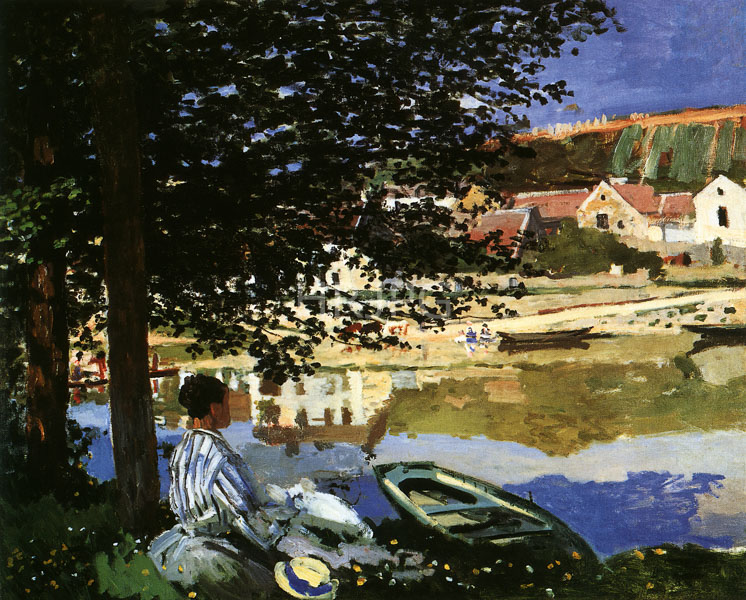
The visual logic of the painting is defined by its extraordinary sense of enclosure and the contrast between light and shade. Monet utilizes the arbor’s foliage to create a dark, textured frame that pushes the viewer’s eye toward the luminous river. The water is rendered with short, horizontal, and rhythmic brushstrokes of white and blue, capturing the flickering reflections of the sky and the village. Camille provides a crucial sense of scale and a human element, her figure integrated into the shaded environment through the play of light on her dress. The village across the river is simplified into rhythmic, geometric forms, its colors muted by the atmospheric haze. He avoids hard outlines, relying instead on the juxtaposition of tonal values to define form and depth. This focus on the sensory 'impression' of the scene—the warmth of the sun and the coolness of the shade—was a radical innovation in landscape painting.
Technically, River Scene at Bennecourt showcases Monet’s early mastery of texture and tonal harmony. He used a confident application of paint to build up the surface of the leaves and the water, giving the scene a tangible presence. He avoids traditional black even in the deepest shadows, using deep blues and purples to maintain a consistent luminosity throughout. Historically, this work represents the birth of the Impressionist spirit, marking a radical break from historical narrative to find beauty in the contemporary environment of the French countryside. Today, held in the collection of the Art Institute of Chicago, the painting is admired for its formal strength and its pioneering spirit. It serves as a vital bridge between his early Realist foundations and the visionary, light-obsessed masterpieces of his later career.