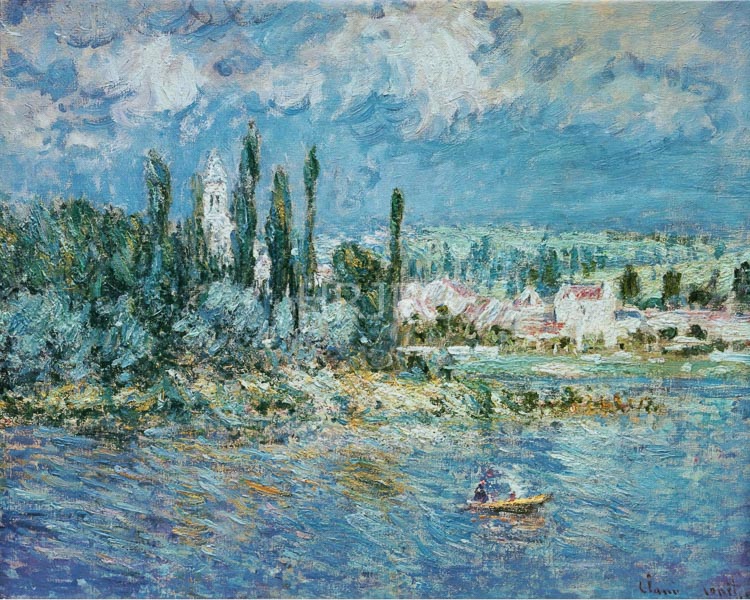
The visual logic of the painting is defined by the extraordinary contrast between the dark, churning clouds of the thunderstorm and the brilliant, eerie light illuminating the land below. Monet utilizes a palette dominated by murky greens, leaden grays, and fiery ochres to represent the stormy 'envelope.' The sky is a masterclass in atmospheric observation, with heavy clouds that suggest the moisture and movement of the turbulent air. The trees in the foreground are rendered with a vigorous, gestural shorthand, appearing to sway under the pressure of the approaching wind. He avoids hard outlines entirely, allowing the atmosphere to blur the boundaries between the land and the sky, creating a unified and immersive environment. The light is the primary actor, raking across the fields and making the colors vibrate with an unnatural intensity just before the rain falls.
Technically, Landscape with Thunderstorm showcases Monet’s mastery of texture and tonal unity. He used thick impasto for the clouds and the foliage, giving the scene a tangible, sculptural presence that reflects the harshness of the environment. He avoids the use of black, using deep indigos and saturated purples in the shadows to maintain the painting's overall luminosity. Historically, the works of 1881 represent a period of intense experimentation, where Monet was testing the limits of the Impressionist method against the most fleeting of natural phenomena. Today, held in major collections such as the Musée d'Orsay and the Art Institute of Chicago, the painting is admired for its raw power and its visionary modernism. It remains a cornerstone of his mid-career achievement, illustrating the perfect union between his revolutionary eye and the natural world he sought to record with such honesty and passion.