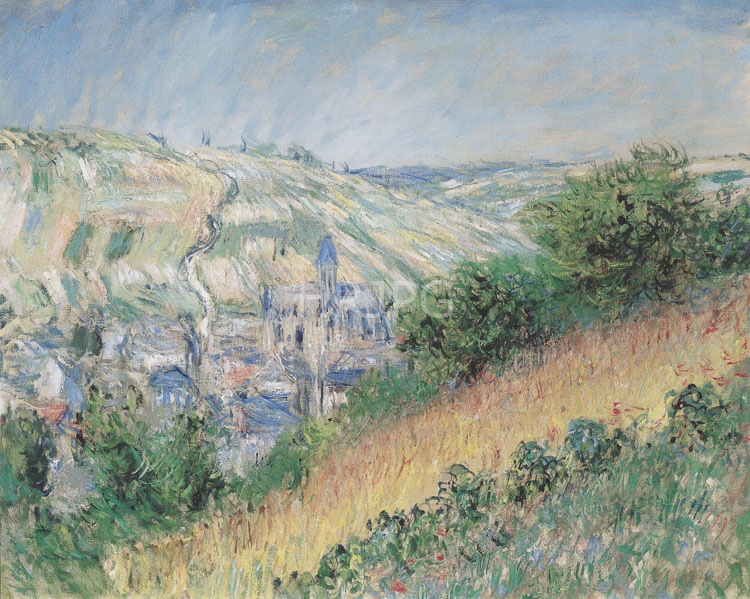
The visual logic of the painting is defined by the extraordinary symmetry between the village and its reflection in the calm surface of the Seine. Monet utilizes a palette dominated by soft blues, pale pinks, and muted ochres to represent the morning light. The river in the foreground acts as a liquid mirror, rendered with horizontal, rhythmic brushstrokes that capture the flickering reflections of the houses and the church spire. He avoids hard outlines entirely, relying instead on the juxtaposition of tonal values to define form and depth. This 'mirror effect' creates a sense of profound stillness and natural order, reflecting Monet’s interest in the decorative patterns of Japanese aesthetics. The light is diffused, creating a unified atmospheric effect that makes the air feel as physical as the stone buildings.
Technically, the 1881 View of Vetheuil showcases Monet’s mastery of 'all-over' texture and his rejection of traditional perspective. He applied the paint in thin, vibrating layers, building up a surface that glows with internal light. He avoids the use of black, using deep indigos and cool greens in the shadows to maintain the painting's overall luminosity. Historically, the Vétheuil series was a major success when exhibited, proving that the Impressionist method could find new, modern poetry in familiar locations. Today, versions of this work are held in major collections such as the Metropolitan Museum of Art and the Musée d'Orsay. It remains a vital document of Monet's creative process, illustrating the bridge between his early outdoor observations and the visionary series of his later years.