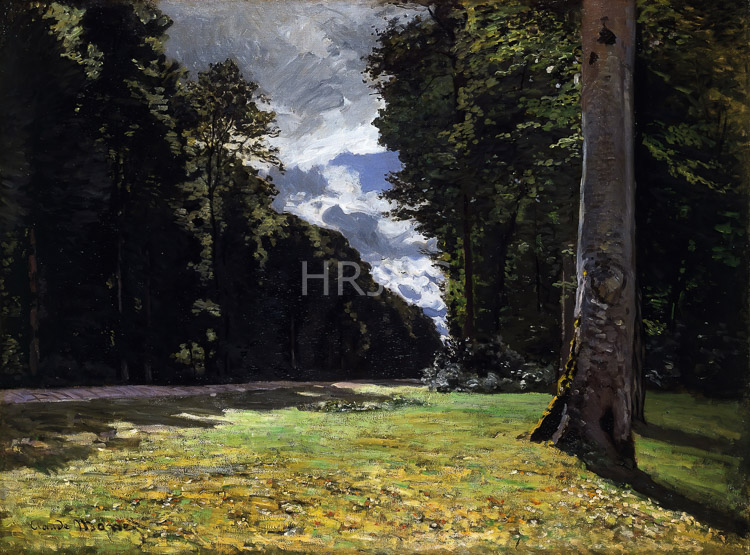
The visual logic of the painting is defined by the extraordinary play of dappled sunlight as it filters through the dense canopy of the trees. Monet utilizes a palette dominated by warm ochres, earthy browns, and deep greens to represent the forest light. The road provides a strong diagonal that leads the eye into the depth of the composition, creating a sense of linear perspective and space. The trees are rendered with a tactile weight, their trunks and foliage captured in a play of light and shadow that suggests the physical presence of the environment. Unlike his later, more ethereal works, the forms here are solid and well-defined, yet the brushwork is already beginning to break free from the polished finish of the Academy. The light is the primary actor, raking across the road and illuminating the edges of the leaves with a natural clarity that makes the scene feel fresh and immediate.
Technically, Le Pavé de Chailly showcases Monet’s early mastery of 'chiaroscuro' and his ability to render texture through color. He used a confident application of paint to build up the surface of the road and the tree trunks, giving the landscape a tangible, sculptural quality. He avoids traditional black even in the shadows, using deep blues and purples to maintain a consistent luminosity throughout. This focus on the optical truth of a single moment—the way the sun catches the dust of the road—prefigures his lifelong obsession with 'instantaneity.' Historically, this painting represents the foundation of Monet’s career and the birth of the Impressionist spirit. Today, held in major collections such as the Musée d'Orsay, it remains a moving testament to his early genius and his unrelenting commitment to recording the world as a symphony of light.