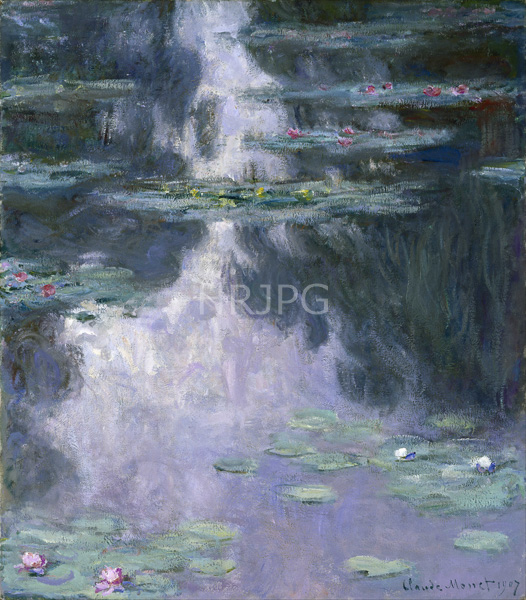
The visual logic of the painting is defined by its extraordinary sense of enclosure and layered depth. Monet utilizes a sophisticated palette of pale blues, soft lavenders, and muted greens to represent the water and the flora. The water lilies act as rhythmic islands of color, their blossoms of rose and pale yellow providing a structural framework within the sea of reflections. The vertical reflections of the weeping willows and the overhead sky create a complex pattern that vibrates across the horizontal plane of the lily pads, creating a sense of immense depth within a shallow environment. The light is diffused and ethereal, suggesting a state of eternal flux. Monet’s focus was not on the individual flowers, but on the 'atmosphere' of the pond—the way the light and water merged into a single, unified impression of natural harmony.
Technically, the 1907 Water Lilies showcases Monet’s mastery of 'broken color' and gestural application. He applied the paint in short, rhythmic dabs and long, fluid strokes, building up a textured surface that has a physical presence of its own. He avoids the use of black, opting for saturated purples and dark indigos in the shadows to maintain the painting's overall luminosity. Historically, the exhibition of these 'waterscapes' in 1909 solidified Monet's reputation as the greatest living painter in France. Today, held in major collections such as the Museum of Fine Arts, Boston, and the Musée d'Orsay, the painting remains a testament to his unrelenting creative spirit and his ability to find a universal, almost spiritual beauty in the simple rhythms of a garden pond.