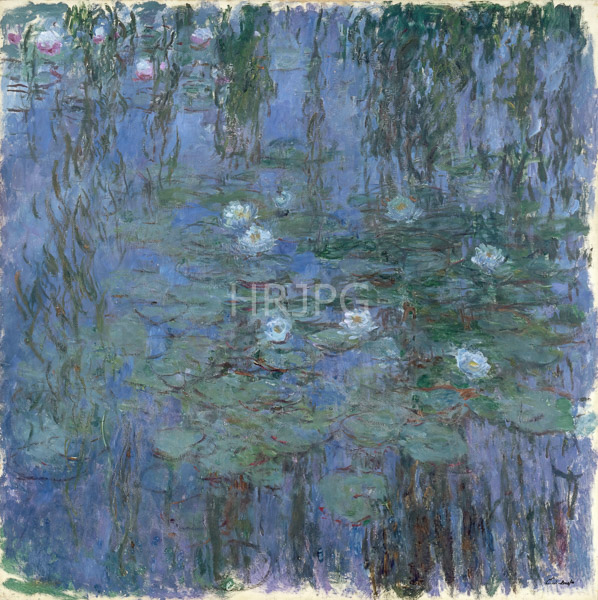
The visual logic of the painting is defined by the complete removal of the horizon line, the shore, and any traditional spatial anchors. The viewer is suspended directly over the liquid mirror of the pond, which Monet renders with a sophisticated and deeply saturated palette of deep indigos, soft lavenders, and murky greens. The water lilies themselves are treated as rhythmic islands of pale light, their white and soft pink blossoms providing a structural framework within the sea of dense reflections. The vertical shadows of the weeping willows and the overhead sky create a complex pattern of depth that vibrates across the horizontal plane of the lily pads. This layering of light and matter creates a sense of infinite, weightless space within a shallow environment—a hallmark of his late-career genius. The light is diffused and ethereal, suggesting a state of eternal flux and quiet, spiritual meditation. Unlike his earlier works, the 'envelope' here is not just atmospheric but psychological, capturing a world that feels both submerged and infinite.
Technically, the Blue Water Lilies showcases Monet’s mastery of 'all-over' texture and chromatic vibration. He applied the paint in thick, rhythmic layers of impasto, giving the surface a physical presence that mirrors the tactile quality of the garden. He avoids the use of black entirely, opting instead for saturated purples and deep blues in the shadows to maintain a high-keyed luminosity even within a somber palette. The brushwork is exceptionally bold and gestural, reflecting the speed and intuition required to record the shifting patterns of light as his vision was increasingly affected by cataracts. This style prefigures the Abstract Expressionist movement of the mid-20th century, where the act of painting itself becomes the subject. Every stroke contributes to a vibrating surface that mimics the sensory experience of human vision—not as a static photograph, but as a living, breathing impression of time and light.
Historically, this work is part of the massive cycle of paintings that Monet eventually donated to the French state, now famously housed in the oval rooms of the Musée de l'Orangerie. Created as a 'refuge for peaceful meditation,' these works marked the ultimate fulfillment of the Impressionist project, where the subject (the pond) became a mere scaffolding for the investigation of pure light. Despite the turmoil of the war years, Monet remained dedicated to his garden, treating it as a sacred laboratory. Today, held in the permanent collection of the Musée d'Orsay, the painting is admired for its formal radicalism and its profound lyrical beauty. It remains a moving testament to Monet’s unrelenting creative spirit and his ability to find a universal, almost spiritual beauty in the simple rhythms of his own garden, forever capturing the heartbeat of the light through a visionary and modern eye.