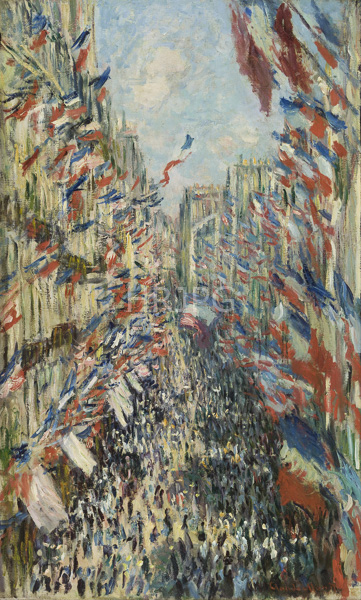
The visual impact of the painting is achieved through the extraordinary high-angled perspective and the rhythmic repetition of the red, white, and blue flags. Monet utilizes a vibrant and saturated palette to represent the festive atmosphere. The street below is rendered as a dark, surging mass of humanity, their forms suggested by quick, staccato brushstrokes that capture the movement of a cheering crowd. The flags are the primary actors in the scene, appearing to flutter and snap in the breeze through his characteristic use of 'broken color.' He avoids hard outlines entirely, relying instead on the vibration of primary colors to define the forms and the depth of the narrow street. The light is diffused yet brilliant, creating a shimmering 'envelope' of air that unifies the architecture with the celebration.
Technically, The Rue Montorgueil showcases Monet’s mastery of gestural application and his rejection of traditional perspective. He applied the paint with a speed and intensity that mirrors the event itself, building up a textured surface that has a physical presence of its own. He avoids the use of black, using deep blues and purples in the shadows to maintain the painting's overall luminosity. Historically, this work was a major professional achievement, demonstrating that the Impressionist method could handle complex, large-scale urban subjects with profound success. Today, housed in the Musée d'Orsay, the painting is admired for its formal strength and its visionary spirit. It remains a cornerstone of 19th-century art, illustrating the moment when the city became a stage for a new visual language of light and motion.