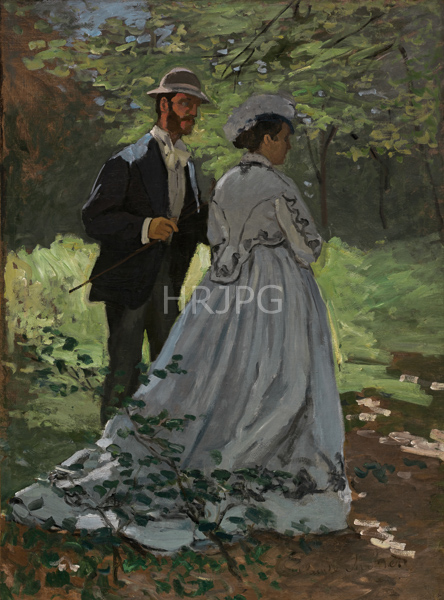
The visual logic of the painting is defined by the extraordinary play of dappled sunlight as it filters through the dense canopy of the Fontainebleau forest. Monet utilizes a palette dominated by warm ochres, deep greens, and brilliant whites to represent the summer light. The figures are treated with a tactile weight, their fashionable garments serving as surfaces for the study of light and reflection. Unlike the static studio-bound portraits of the era, Monet’s walkers are unified by the 'envelope' of warm air and the shifting patterns of the forest light. The tree trunks provide a series of strong vertical accents that create a sense of depth and spatial order. He avoids hard outlines, relying instead on the juxtaposition of tonal values to define the forms, making the figures feel as if they are truly moving through the atmospheric space.
Technically, The Walkers showcases Monet’s early mastery of texture and his rejection of traditional chiaroscuro. He used a confident application of paint to build up the surface of the forest floor and the foliage, giving the scene a tangible, sculptural presence. He avoids traditional black even in the deepest shadows, using deep blues and purples to maintain the painting's overall luminosity. Historically, this work represents the foundation of Monet’s career and the birth of the Impressionist spirit, marking a radical break from historical narrative to find beauty in the contemporary environment. Today, held in major collections such as the Musée d'Orsay and the National Gallery of Art, the painting is admired for its formal strength and its pioneering spirit, reminding us that for Monet, the natural light was the ultimate teacher.