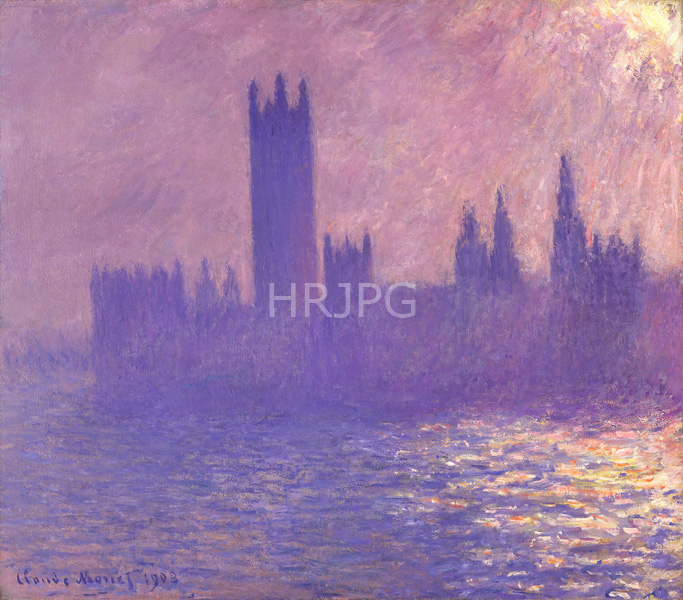
The visual logic of the painting is defined by the extraordinary contrast between the dark, silhouetted form of the parliament buildings and the brilliant, golden light of the sky. Monet utilizes a palette dominated by warm ochres, deep violets, and brilliant oranges. The sun, appearing as a fiery disk, filters through the dense air, turning the smog into a glowing, iridescent veil. The Houses of Parliament are rendered as a massive, simplified form of light and shadow, their rhythmic spires and arches creating a vertical counterpoint to the horizontal expanse of the Thames. The water in the foreground is a masterclass in reflection, rendered with horizontal, rhythmic brushstrokes that capture the flickering light and the dark shadows of the building. He avoids hard outlines, relying entirely on the vibration of color to define form and depth.
Technically, the London series pushed Monet to the limits of his optical observation. The surface of the painting is built up with thick, crusty layers of impasto, giving it a tactile quality that mirrors the moisture-laden atmosphere. He avoids the use of black entirely, using deep indigos and saturated purples in the shadows to maintain the painting's high-keyed luminosity despite the silhouette effect. Historically, the exhibition of the London works in 1904 was a massive success, hailed as a triumph of modern vision. Today, versions of this work are held in major museums such as the National Gallery in London and the Brooklyn Museum. It remains a cornerstone of modern art history, illustrating the moment when art broke away from descriptive realism to embrace the visionary power of pure light, turning a monument of government into a monument of sight.