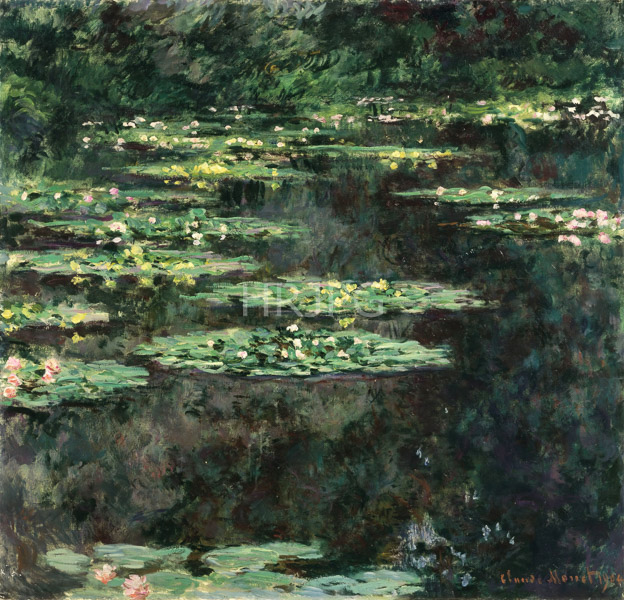
The visual logic of the painting is defined by its extraordinary sense of enclosure and the deliberate layering of organic forms. Unlike his final 'Grandes Décorations' where the horizon is completely abolished, this 1904 composition still suggests a spatial orientation through the dense, dark greenery of the bank at the top of the canvas. Monet utilizes a sophisticated palette dominated by deep forest greens, murky ochres, and cool emeralds to represent the water's depths. The water lilies are treated as rhythmic, floating islands of brilliant white and soft rose, their circular pads providing a structural framework that leads the viewer’s eye through the composition. The reflections of the overhead foliage create a complex, vertical pattern that vibrates across the horizontal plane of the lily pads, creating a sense of immense depth within a shallow, flat environment. This interplay between the thing itself (the lily) and the image of the thing (the reflection) serves as a profound meditation on the nature of reality and perception.
Technically, the 1904 Water Lilies showcases Monet’s absolute mastery of texture and the rejection of traditional perspective. He applied the paint in thick, rhythmic layers of impasto, giving the blossoms a tangible, sculptural presence that stands out against the more fluid and blended brushwork of the water. He avoids the use of black entirely, opting instead for saturated purples and deep indigos in the shadows to maintain a high-keyed luminosity despite the somber, shaded palette. Every stroke is designed to capture the sensory 'impression' of a specific moment—the warmth of the filtered sun on the blossoms and the damp, cool air of the pond. This 'all-over' texture ensures that the canvas vibrates with energy, mimicking the actual experience of human vision, which perceives light not as a static image but as a continuous, shimmering vibration of color.
Historically, the works produced during this 1904 campaign were a central highlight of the legendary 1909 exhibition at the Durand-Ruel gallery in Paris, titled 'Les Nymphéas, séries de paysages d'eau.' This exhibition was a massive critical success, hailed by contemporary critics as a triumph of modern vision and a 'monument of sight.' It marked the moment when art broke away from descriptive realism to embrace the visionary power of pure light, turning a private garden into a universal language of emotion and peace. Today, versions of the 1904 series are held in major institutions worldwide, including the Musée d'Orsay and the Denver Art Museum. The painting remains a moving testament to Monet’s unrelenting creative spirit and his ability to find a universal, almost spiritual beauty in the simple rhythms of his own garden. It illustrates the perfect union between the artist’s eye and the environment he so passionately recorded, reminding us that for Monet, the world was a continuous symphony of light and reflection, forever captured through an honest and revolutionary eye.