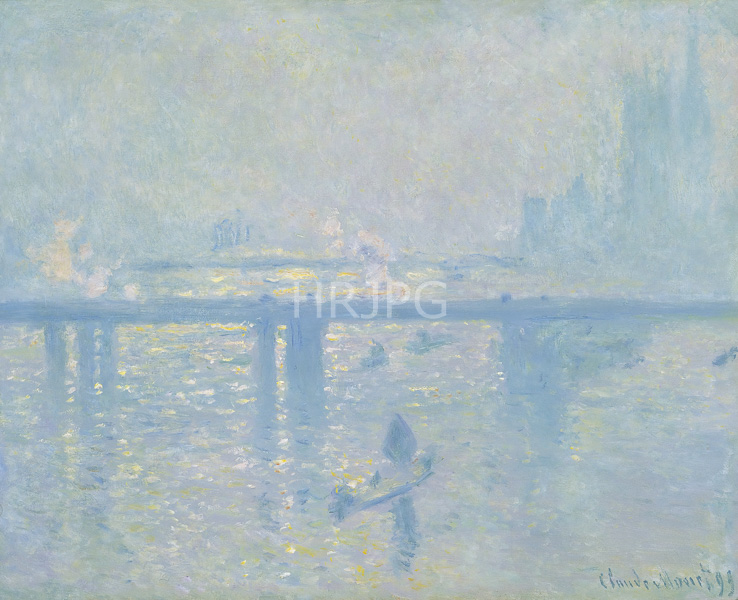
The visual logic of the painting is defined by the rhythmic sequence of the bridge's arches and the distant silhouette of the Houses of Parliament. Monet utilizes a sophisticated palette of pale blues, soft lavenders, and murky yellows to represent the moisture-laden atmosphere. The sun, appearing as a faint, glowing disk, struggles to penetrate the dense fog, casting a shimmering glow across the water. The Thames in the foreground is rendered with horizontal, rhythmic brushstrokes that capture the flickering reflections of the sky and the dark, blurred shapes of river traffic. He avoids hard outlines entirely, relying instead on the vibration of color to define form and depth. This focus on the dissolution of solid objects under the influence of light was the ultimate goal of his London campaign.
Technically, the Charing Cross Bridge series showcases Monet’s mastery of 'all-over' texture. He applied the paint in thick, vibrating layers of impasto, giving the surface a physical presence that mimics the tactile quality of the heavy air. He avoids the use of black, using deep indigos and saturated purples in the shadows to maintain the painting's high-keyed luminosity despite the overcast conditions. Historically, the London series was a massive success when exhibited in 1904, proving that the Impressionist method could find poetry in even the most industrial of settings. Today, versions of this work are held in major collections such as the Thyssen-Bornemisza Museum and the Art Institute of Chicago. It remains a beloved icon of modern art, illustrating the moment when art broke away from descriptive realism to embrace the visionary power of pure light and atmosphere.