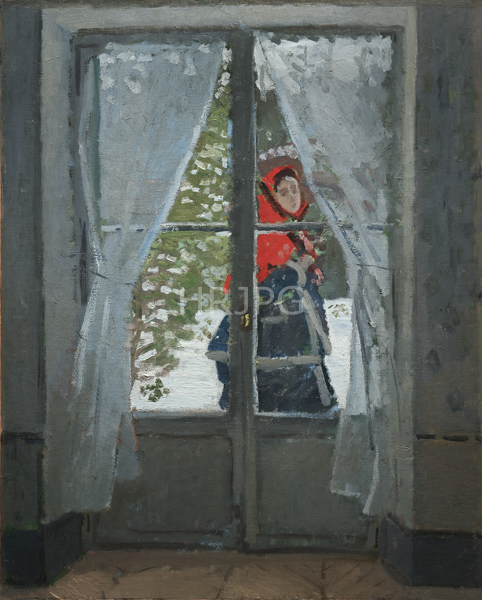
The visual center of the painting is the brilliant red of Camille’s kerchief, which Monet renders as a pure, high-contrast focal point against the muted grays and whites of the snow-covered garden. This red is a primary actor, drawing the eye directly to Camille’s face and her steady, enigmatic gaze. The window frame provides a strong structural framework for the composition, creating a sense of a 'picture within a picture.' Monet utilizes a palette dominated by icy blues, soft pinks, and warm ochres to represent the winter light. The shadows across the snow are rendered in deep purples and indigos, reflecting the color of the clear sky. He avoids the rigid finish of traditional portraiture, favoring a more textured and gestural application of paint that reflects the movement of the air and the 'instantaneity' of the glance.
Technically, The Red Kerchief showcases Monet’s mastery of 'all-over' texture and the rejection of traditional perspective. He used a confident application of paint to build up the surface of the snow and the fabric, giving the scene a tangible presence. He avoids the use of black, using deep blues in the shadows to maintain a high-keyed luminosity despite the interior setting. Historically, this work remains a beloved icon of Monet’s biography, reflecting the deep emotional connection to his primary muse. Today, held in the Cleveland Museum of Art, the painting is admired for its formal strength and its haunting beauty. It remains a moving testament to the artist’s ability to find a monumental beauty in the most fleeting of domestic moments, illustrating the perfect union between his revolutionary eye and the human heart.