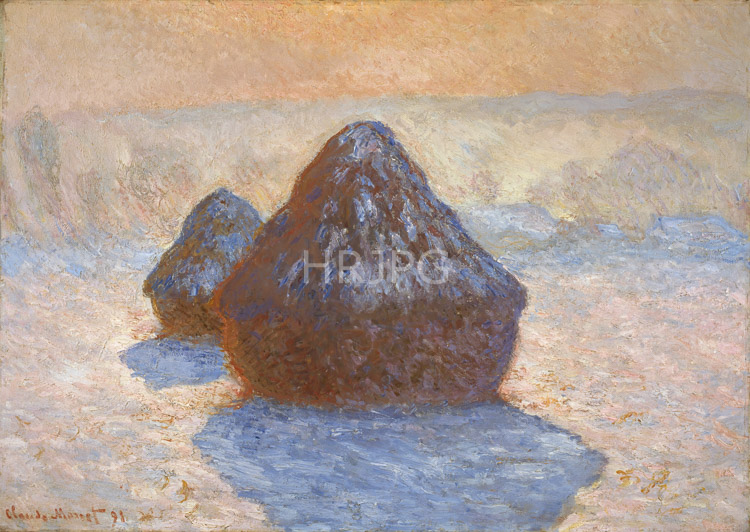
The visual center of the painting is the pair of haystacks, anchoring the composition with their heavy, conical forms. Under the cool, raking light of the morning sun, the frost is revealed to be a tapestry of pale pinks, soft violets, and icy blues. Monet uses a palette of high-keyed colors to suggest the crispness of the winter air, while the long shadows stretching across the field are rendered in deep purples and indigos. This treatment of shadows was a radical innovation, showing that shadows in snow and frost are filled with reflected light from the sky. The horizon line is relatively low, granting the sky and its moisture-laden atmosphere a dominant role in establishing the painting’s serene and contemplative mood. He avoids hard outlines, relying on the vibration of color against color to define the volume of the hay.
Technically, Haystacks, White Frost Effect showcases Monet’s mastery of 'all-over' texture. He applied paint in thick, crusty layers of impasto to mimic the physical presence of the frozen hay and the earth. He worked on multiple canvases simultaneously, moving between them as the light moved every few minutes to capture the precise 'instantaneity' of the moment. Historically, the exhibition of the Haystacks series in 1891 was a watershed success, influencing a generation of future modernists toward abstraction. Today, held in major collections such as the Art Institute of Chicago and the J. Paul Getty Museum, the painting remains a testament to Monet’s genius in elevating the mundane into the extraordinary, reminding us that for him, the world was a continuous symphony of light and reflection.