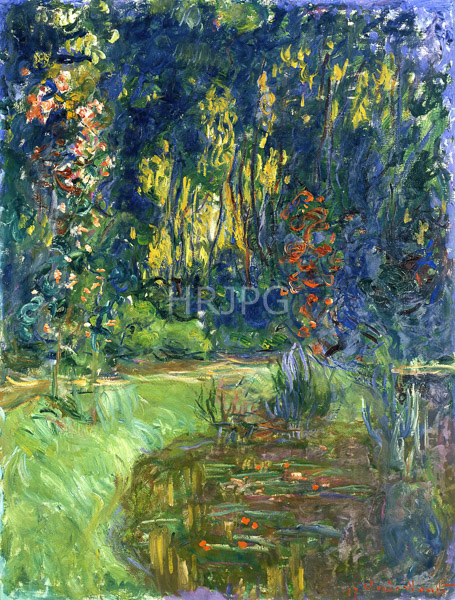
The visual logic of the painting is defined by the complete removal of the shore and the horizon. The viewer is suspended over the liquid mirror of the water, which Monet renders with a sophisticated palette of deep emeralds, murky indigos, and soft violets. The water lilies are treated as rhythmic islands of color, their blossoms of white and pale rose providing a structural framework within the sea of reflections. The vertical reflections of the weeping willows and the overhead sky create a complex pattern of depth that vibrates across the horizontal plane of the lily pads. This layering of light and matter creates a sense of infinite space within a shallow environment, a hallmark of his late-career genius. The light is diffused and ethereal, suggesting a state of eternal flux and quiet meditation. He avoids hard outlines entirely, relying on the vibration of color to define form.
Technically, the 1917 Water-Lily Pond showcases Monet’s transition into a more gestural and 'all-over' style. He applied the paint in thick, rhythmic layers of impasto, giving the surface a physical presence of its own. He avoids the use of black, using saturated purples and deep blues to maintain a high-keyed luminosity. Historically, the works of 1917 were the foundation for his final 'Grandes Décorations' for the French state. Today, held in major collections such as the Musée Marmottan Monet, the painting is admired for its formal radicalism and its profound lyrical beauty. It remains a moving testament to Monet’s unrelenting creative spirit and his ability to find a universal, almost spiritual beauty in the simple rhythms of his own garden, forever capturing the heartbeat of the light through a visionary and modern eye.