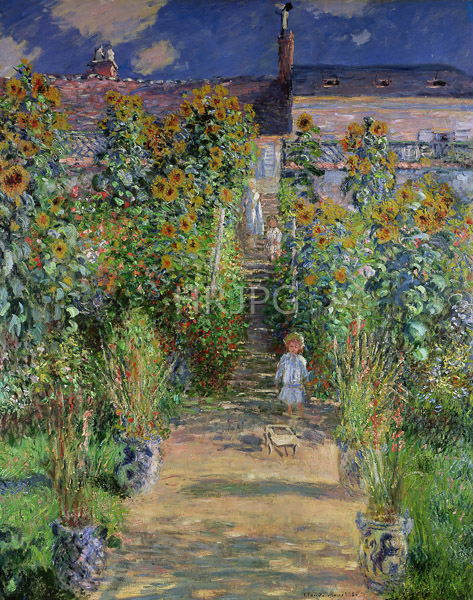
The visual logic of the painting is defined by the extraordinary verticality of the sunflowers and the rhythmic diagonal of the garden steps. Monet utilizes a vibrant palette of brilliant yellows, deep emeralds, and azure blues to represent the high summer light. The sunflowers provide a series of rhythmic accents that frame the composition, their massive flower heads catching the golden light. The children provide a crucial sense of scale and a human element, highlighting the vitality of the domestic garden. The light filters through the foliage, creating a dappled pattern of highlights across the path and the stairs, suggesting the warm, still atmosphere of a Mediterranean-like summer in the Seine Valley. He avoids hard outlines, relying instead on the vibration of color against color to define form and depth.
Technically, Monet's Garden at Vetheuil showcases his mastery of 'all-over' texture and the rejection of traditional perspective. He used a confident application of paint to build up the surface of the flowers and the path, giving the scene a tangible presence. He avoids the use of black, using deep blues and purples in the shadows to maintain a high-keyed luminosity. Historically, the Vétheuil garden works reflect the stability Monet found before the eventual move to Giverny. Today, held in major collections such as the National Gallery of Art in Washington, D.C., the painting is admired for its lyrical beauty and its pioneering spirit. It remains a cornerstone of his mid-career achievement, illustrating the perfect union between his revolutionary eye and the natural world he sought to record with such passion and honesty, reminding us that for Monet, the beauty of the world was found in the vibration of the light.