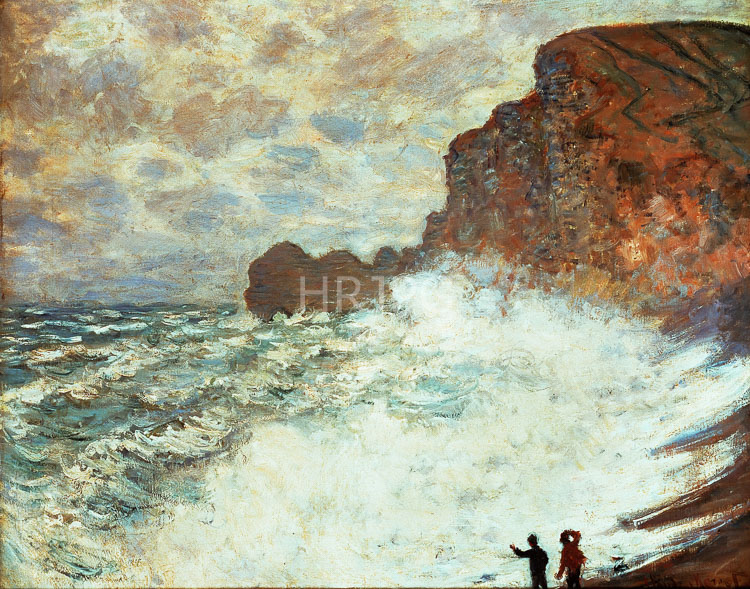
The visual center of the painting is the turbulent surface of the sea, which Monet renders with an extraordinary complexity of brushwork. He utilizes a palette dominated by murky greens, deep indigos, and brilliant, foamy whites to suggest the weight and movement of the breaking waves. The rhythmic, horizontal slashes of paint create a vibrating surface that mimics the chaotic energy of the water as it crashes against the shore. The sky is a masterclass in atmospheric observation, with heavy, gray-blue clouds that suggest a storm-tossed air. The light is diffused and cool, reflecting the unique lighting conditions of a tempestuous day in Northern France. He avoids hard outlines, allowing the mist and spray to blur the boundaries between the water and the sky, creating a unified and immersive environment that makes the viewer feel the power of the wind.
Technically, Stormy Weather at Etretat showcases Monet’s move toward a more gestural and expressive application of paint. He used thick impasto for the crests of the waves, giving the water a tangible, sculptural presence that contrasts with the thinner, more atmospheric washes used for the horizon. He avoids traditional black even in the deepest troughs, using saturated purples and cool blues to maintain the painting’s overall luminosity. Historically, this work represents the foundation of his mature series practice, proving that the identity of the sea was a fluid construct shaped entirely by the weather. Today, held in major collections such as the National Gallery of Norway or the Musée d'Orsay, it remains a moving testament to Monet’s resilience and his unrelenting quest to find universal beauty in the raw forces of nature.