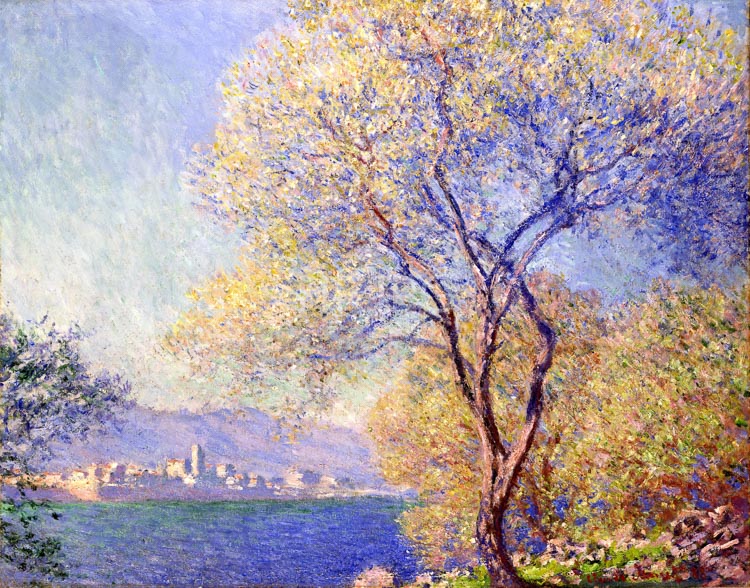
The visual logic of the painting is defined by the extraordinary intensity of the morning light. Monet utilizes a palette dominated by brilliant turquoises, deep emeralds, and sun-baked ochres, creating a vibrating surface that mimics the sensation of heat. The Salis garden, with its twisted olive trees, provides a rhythmic structural framework for the composition. The distant silhouette of the town of Antibes and the snow-capped Alps are rendered with a soft, atmospheric touch, their forms simplified by the Mediterranean haze. The sunlight filters through the branches, creating a complex pattern of dappled light across the ground. Monet’s mastery of color theory is at its peak here; he shows how the intense sun bleaches the foliage while creating deep, saturated shadows filled with vibrant purples and blues rather than traditional black, ensuring a high-keyed luminosity throughout.
Technically, Antibes seen from the Salis Garden showcases Monet’s move toward a more visceral and expressive application of paint. He uses thick impasto to build up the texture of the trees and the earth, giving the landscape a tangible, sculptural presence. The sea in the background is rendered with horizontal strokes of pure blue and white, suggesting the transparency and movement of the water. He avoids hard outlines, relying entirely on the vibration of color to define form and depth. Historically, the Antibes series was a critical success, proving that the Impressionist method could be applied to environments far removed from the Seine Valley. Today, held in major collections like the Museum of Fine Arts, Boston, the painting is admired for its freshness and its radical modernism. It serves as a vital link in Monet’s career, demonstrating his move toward pure, expressive color.