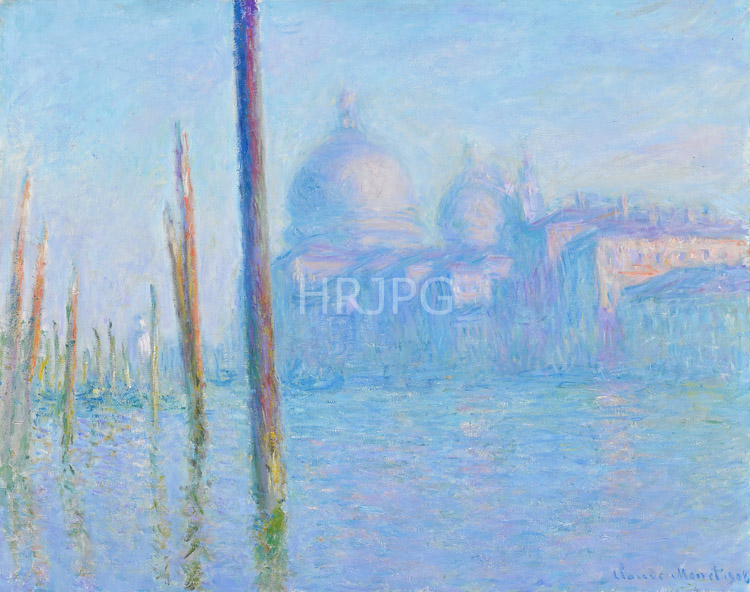
The visual logic of the painting is defined by its extraordinary tonal harmony and the rhythmic reflections in the water. Monet utilizes a palette dominated by warm ochres, pale pinks, and brilliant azures. The palaces are rendered as massive, simplified forms of light and shadow, their rhythmic windows and arches providing a structural framework for the composition. The Grand Canal in the foreground is a liquid mirror, rendered with horizontal, rhythmic strokes that capture the flickering reflections of the sky and the architecture. He avoids hard outlines, allowing the moisture-laden air of the lagoon to blur the boundaries between the water and the stone. This 'mirror effect' creates a sense of profound stillness and natural order, reflecting Monet’s interest in the decorative patterns and flattened space of Japanese aesthetics.
Technically, The Grand Canal showcases Monet’s mastery of tonal harmony and the rejection of traditional perspective. He applied the paint in thick, vibrating layers of impasto, giving the surface a physical presence of its own. He avoids the use of black, using deep indigos and violets in the shadows to maintain the painting's high-keyed luminosity. Historically, the Venice series was a critical sensation when exhibited in 1912, proving that his method could handle the most famous of European vistas with profound success. Today, held in major collections such as the Museum of Fine Arts, Boston, and the National Gallery of Art, the painting remains a beloved icon of late Impressionism. It illustrates the perfect union between the artist’s revolutionary eye and the timeless beauty of the Italian lagoon, capturing the essence of Venice as a city of light and reflection.