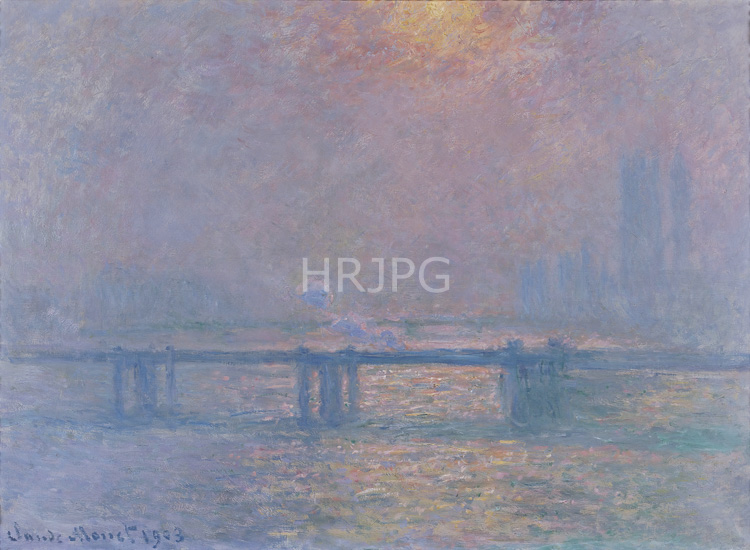
The visual center of the painting is the repetitive sequence of the bridge's arches and the distant silhouette of the Houses of Parliament. Monet utilizes a sophisticated palette of pale blues, soft lavenders, and murky yellows to represent the moisture-laden atmosphere. The sun, a hidden but powerful presence, filters through the dense fog, turning the smog into a glowing, iridescent veil. The surface of the Thames in the foreground is rendered with horizontal, rhythmic brushstrokes that capture the shimmering reflections of the hidden light and the dark shapes of river traffic. There is no hard line and no traditional perspective; the entire scene is a study in tonal variation and value relationships, creating a dreamlike atmosphere that reflects the modern urban experience and the dissolution of form under the influence of the atmosphere.
Technically, the London series pushed Monet to the limits of his optical observation. Because the conditions were so fleeting, many of these works were finished in Giverny, where he used his memory to harmonize the series. The brushwork in Charing Cross Bridge is dense and tapestry-like, with thousands of small, rhythmic marks of color that create a vibrating, textured surface. Historically, the exhibition of the London works in 1904 was a critical success, praising his ability to capture the 'invisible' air. Today, versions of this work are held in major museums worldwide, including the Art Institute of Chicago and the Musée d'Orsay. It remains a masterpiece of late Impressionism, illustrating the bridge between 19th-century landscape tradition and the emerging abstract tendencies of modernism, forever capturing the heartbeat of London through the lens of light.