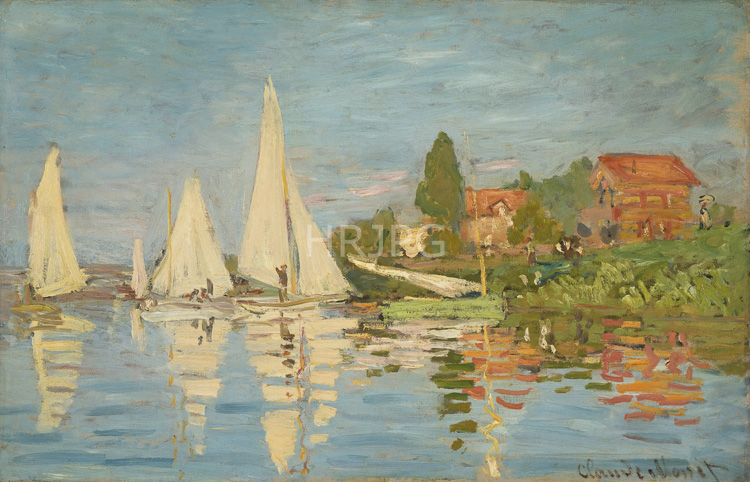
The visual center of the painting is the extraordinary play of reflections in the water of the Seine. Monet utilizes a vibrant and saturated palette of azure blues, brilliant reds, and warm ochres. The sailboats, with their white sails and rhythmic masts, provide a strong structural framework for the composition. The water in the foreground is a masterclass in Impressionist technique; Monet uses short, horizontal slashes of pure color—red, blue, and white—to represent the flickering reflections of the sky and the boats. These strokes are not blended, allowing the viewer’s eye to perform the 'optical mixing' that creates a sense of sparkling, moving light. The sky is a masterclass in atmospheric light, with pale blues and soft, scudding clouds that suggest a warm, breezy day.
Technically, Regatta at Argenteuil showcases Monet’s mastery of 'all-over' texture and the rejection of traditional perspective. He avoids the use of black entirely, opting for deep indigos and cool greens to suggest the shadows of the boats and trees. This ensures that the painting maintains a consistent luminosity across the entire surface. Historically, the Argenteuil paintings represent the moment when Impressionism reached its most cohesive and celebratory phase, reflecting the prosperity and peace of post-war France. Today, held in the collection of the Musée d'Orsay, the painting is admired for its formal strength and its pioneering spirit. It remains a cornerstone of modern art history, illustrating the perfect union between the artist’s revolutionary eye and the rapidly changing world of the late 19th century, reminding us that for Monet, every subject was a vehicle for the exploration of light.