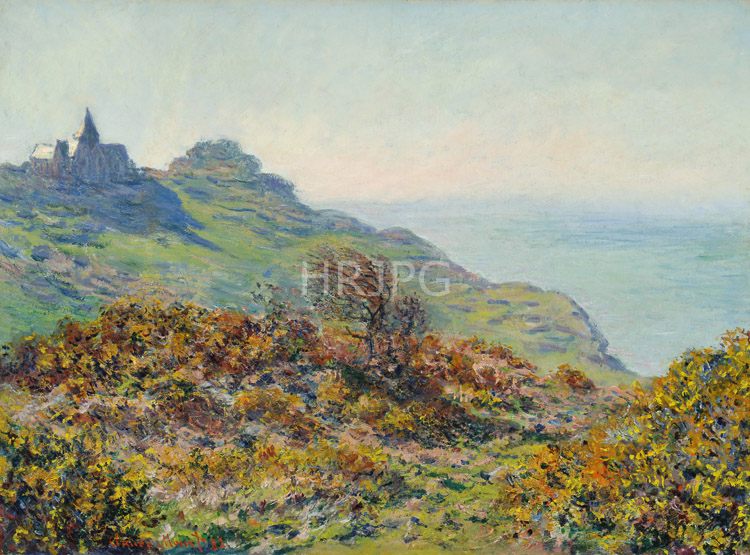
The visual logic of the painting is defined by the high-angled perspective and the dramatic contrast between the massive cliff and the distant horizon. Monet utilizes a palette of warm ochres, deep violets, and brilliant turquoises to represent the coastal environment. The church provides a rhythmic focal point that anchors the composition, its silhouette rendered with a soft, atmospheric touch. The sea in the background is a masterclass in reflection, with horizontal strokes of blue and white that capture the shimmering intensity of the afternoon sun. He avoids hard outlines, relying instead on the juxtaposition of tonal values to define the forms and the depth of the gorge. The light is the primary actor, raking across the cliff and creating deep, chromatic shadows filled with cool blues and purples rather than traditional black, maintaining a consistent luminosity.
Technically, The Church at Varengeville showcases Monet’s mastery of 'all-over' texture. He used a confident, impasto technique to build up the surface of the cliffs, giving the landscape a tangible, sculptural presence. Historically, the Varengeville series was a major triumph for the artist, proving that the Impressionist method could handle subjects of monumental structure and atmospheric beauty with profound success. Today, versions of this work are held in major collections such as the Musée d'Orsay and the Barber Institute of Fine Arts. It remains a cornerstone of modern art, illustrating the moment when art broke away from descriptive realism to embrace the visionary power of pure light and color. It serves as a reminder that for Monet, the act of seeing was a continuous adventure into the infinite complexities of the visual world.