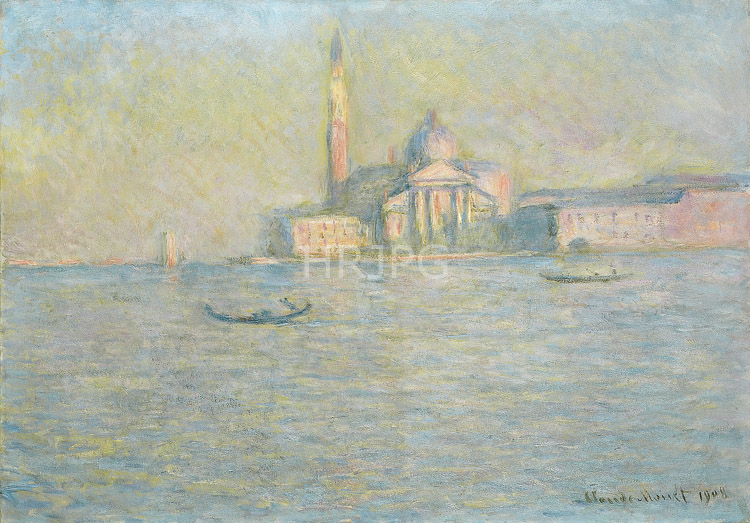
The visual impact of the painting is achieved through its extraordinary palette of deep azure, soft violet, and brilliant ochre. The silhouette of San Giorgio Maggiore is positioned near the center of the horizon, its dark form providing a structural verticality that contrasts with the horizontal sprawl of the lagoon. Monet utilizes a sophisticated range of colors to suggest the warmth of the autumn sun hitting the ancient stone, while the Grand Canal in the foreground is rendered with rhythmic, horizontal brushstrokes that capture the flickering reflections of the sky. He avoids hard outlines, allowing the moisture-laden atmosphere of the lagoon to blur the boundaries between the architecture and the water. This focus on the 'instantaneity' of the light—capturing the visual sensation of a single moment—was the ultimate goal of his Venetian campaign.
Technically, San Giorgio Maggiore showcases Monet’s mastery of tonal harmony and the rejection of traditional chiaroscuro. He applied the paint in thick, vibrating layers of impasto, giving the surface a physical presence of its own. He avoids the use of black, using deep indigos and violets in the shadows to maintain the painting's high-keyed luminosity. Historically, the Venice series was a critical sensation when exhibited in 1912, proving that his method could handle the most famous of European vistas with profound success. Today, versions of this work are held in major institutions like the National Museum Cardiff and the Indianapolis Museum of Art. It remains a masterpiece of late Impressionism, illustrating the perfect union between the artist’s revolutionary eye and the timeless beauty of the Italian lagoon.