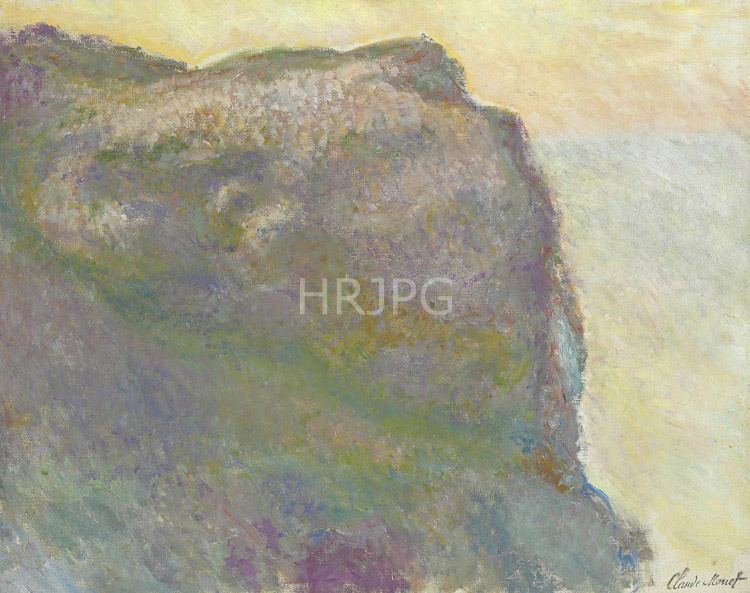
The visual logic of the painting is defined by the extraordinary mass of the cliff and its interaction with the misty air of the English Channel. Monet utilizes a sophisticated and restricted palette of pale pinks, soft violets, and murky greens to represent the coastal atmosphere. The sky is a masterclass in tonal variation, with layers of moisture-laden clouds that blur the distant horizon and soften the profiles of the rocks. The cliff is rendered as a monumental, almost ethereal presence, its forms simplified by the haze of the maritime day. The water in the foreground is treated with horizontal, rhythmic strokes that suggest the gentle movement of the tide and the reflection of the leaden sky. He avoids hard outlines entirely, relying on the juxtaposition of tonal values to define the forms and the immense depth of the coastal space.
Technically, Cliff at Petit Ailly showcases Monet’s mastery of 'all-over' texture and the rejection of traditional perspective. He used a high horizon line to emphasize the vertical scale of the cliff, creating a sense of immersion. The brushwork is delicate and blended, capturing the tactile quality of the damp, salt-laden air. He avoids the use of black, using deep blues and purples in the shadows to maintain a high-keyed luminosity despite the overcast conditions. Historically, the works of 1896-1897 represent a period of artistic synthesis for Monet, where he combined his early interest in topography with his late-career obsession with series painting. Today, versions of this work are held in major collections such as the Metropolitan Museum of Art and the Musée d'Orsay. It remains a cornerstone of modern art, illustrating the perfect union between his revolutionary eye and the natural world he sought to record with such honesty and passion.