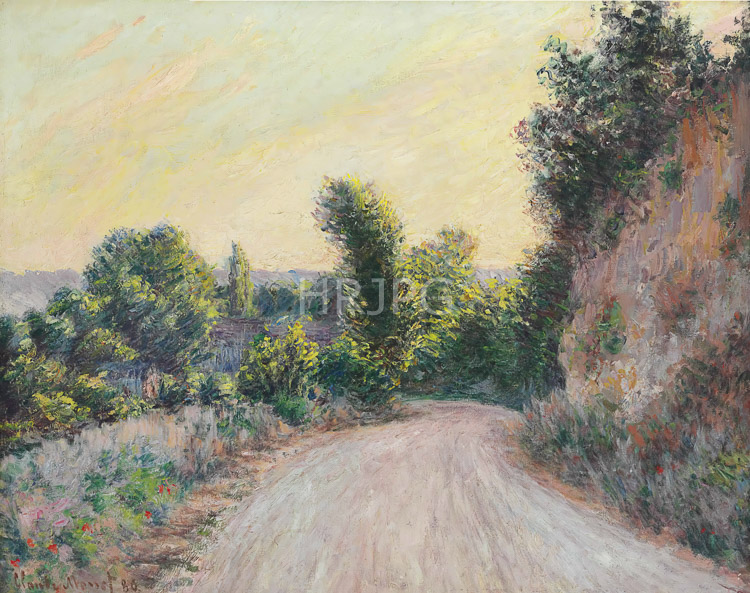
The visual logic of the painting is defined by the extraordinary symmetry between the autumn foliage and its reflection in the calm, mirror-like surface of the river. Monet utilizes a rich and varied palette of fiery ochres, deep emeralds, and soft violets to represent the seasonal transition. The trees along the bank form a rhythmic vertical screen that is doubled in the water, creating a sense of immense depth and spatial ambiguity. There is no central focal point; the eye is encouraged to wander through the depth of the reflections, following the play of light across the leaves and the water’s surface. This 'mirror effect' creates a sense of profound stillness and natural order, reflecting Monet’s interest in the decorative patterns and flattened space of Japanese aesthetics.
Technically, The Arm of Jeufosse Autumn showcases Monet’s mastery of 'all-over' texture and the rejection of traditional chiaroscuro. He used a confident, impasto technique to build up the surface of the foliage, giving the trees a tangible, sculptural presence. He avoids the use of black entirely, using deep blues and purples in the shadows to maintain the painting's overall luminosity. This chromatic approach ensures that every inch of the canvas vibrates with light, capturing the 'instantaneity' of the autumn day before the leaves fell. Historically, the Jeufosse works represent a critical step in Monet’s evolution toward the series-based practice of the 1890s. Today, held in major collections such as the Museum of Fine Arts, Boston, and the Musée d'Orsay, the painting is admired for its lyrical beauty and its technical virtuosity. It remains a cornerstone of his mid-career achievement, illustrating the perfect union between his revolutionary eye and the natural world he sought to record with such honesty and passion.