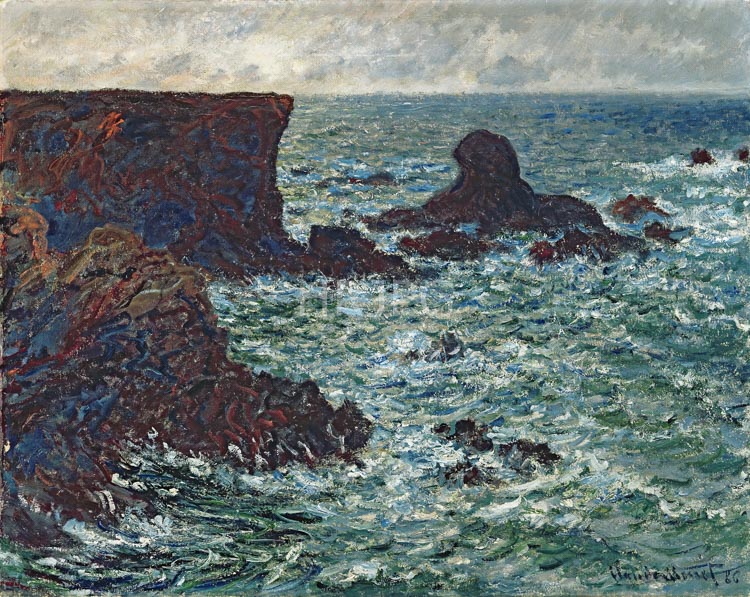
The visual logic of the painting is defined by the extraordinary verticality of the rocks and the rhythmic movement of the water. Monet utilizes a palette of deep indigos, murky greens, and earthy purples to represent the 'savage' nature of the Brittany coast. The sky is a masterclass in atmospheric observation, with heavy clouds that diffuse the light across the landscape. The sea in the foreground is rendered with short, rhythmic, and horizontal strokes of white and blue, capturing the churning energy of the waves and the spray of the foam. He avoids hard outlines, allowing the atmosphere to blur the boundaries between the rock and the water, creating a unified and immersive environment. The light is diffused and cool, reflecting the unique atmospheric quality of a stormy day in the Atlantic.
Technically, The Lion showcases Monet’s mastery of texture and tonal unity. He used thick impasto to build up the surface of the rocks, giving them a tangible, sculptural presence that reflects the harshness of the environment. He avoids the use of black entirely, using saturated blues and purples in the shadows to maintain the painting's overall luminosity. Historically, the Belle-Ile works were highly successful when exhibited, proving that the Impressionist method could be applied to environments far removed from the Seine Valley. Today, versions of this work are held in major collections such as the Musée d'Orsay and the Cincinnati Art Museum. It remains a cornerstone of his mid-career achievement, illustrating the perfect union between his revolutionary eye and the natural world he sought to record with such honesty and passion.