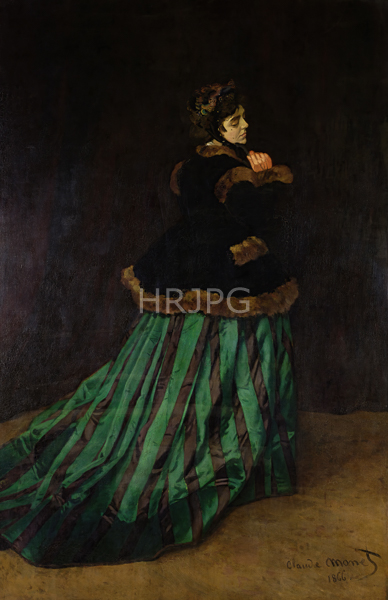
The visual center of the painting is the extraordinary rendering of the green silk dress, which flows with a life of its own. Monet utilizes a rich palette of deep emerald, charcoal, and brilliant highlights to suggest the weight and shimmer of the fabric. The way the light catches the folds of the silk creates a sense of movement and volume that is incredibly tangible. Camille is depicted turning away from the viewer, a pose that adds a sense of immediacy and psychological depth to the work. The background is a dark, neutral space that pushes her figure directly toward the viewer, creating a confrontational and modern experience. He avoids the rigid, polished finish of the Academic tradition, favoring a more textured and gestural application of paint that reflects the influence of Édouard Manet.
Technically, The Woman in the Green Dress showcases Monet’s early mastery of tonal values and his ability to render texture through color. He used a confident application of paint to build up the surface of the fur-trimmed jacket and the silk, giving the garments a physical presence. The shadows are rendered with a sophisticated range of dark tones that avoid flat black, creating a sense of depth and luminosity. Historically, this work was a critical triumph, praised for its realism and its bold technique. It represents a moment when Monet was balancing his desire for institutional success with his growing commitment to a new visual language. Today, held in the Kunsthalle Bremen, the painting is admired for its formal strength and its unique place in Monet’s biography. It remains a moving testament to his early genius and his deep connection to the woman who would inspire his greatest masterpieces.