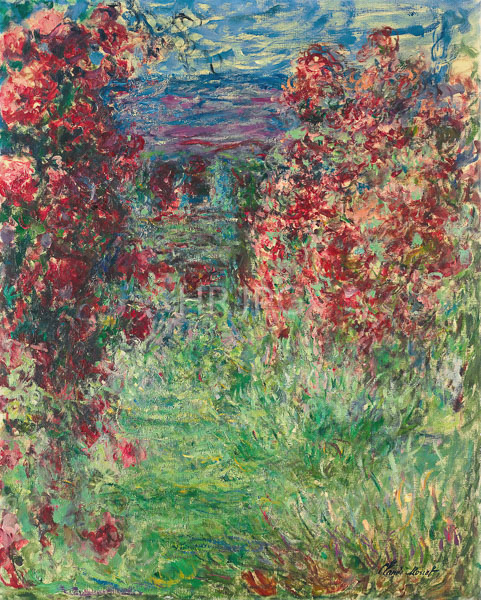
The visual logic of the painting is defined by its extraordinary sense of movement and its 'all-over' composition. The house is barely visible through the cascading roses, which Monet renders as rhythmic swaths of color that seem to vibrate across the canvas. He utilizes an intense and non-naturalistic palette of deep mauves, vibrant purples, and murky greens, reflecting the way his cataracts caused him to perceive color with an extreme, fiery saturation. There is no horizon and no traditional perspective; the viewer is plunged into the very heart of the blossoms, experiencing the garden as a total and overwhelming emotional environment. The brushwork is exceptionally bold and gestural, with large, sweeping arcs of paint that create a vibrating, textured surface. This style prefigures the Abstract Expressionism of the mid-20th century.
Technically, The House Among the Roses showcases Monet’s mastery of 'chromatic vibration' and his intuitive handling of the medium. He used large brushes to apply the paint in thick, crusty layers of impasto, giving the floral clusters a tangible, sculptural presence despite their near-abstraction. He avoids traditional lines, relying entirely on the vibration of color and value to suggest the weight and fluid movement of the garden. The dark, saturated shadows within the foliage are filled with deep indigos and violets, creating a somber yet luminous tone that is punctuated by flashes of brilliant pink. This approach creates a sense of shimmering movement, making the viewer feel the physical sensation of the air and the rhythmic heartbeat of the Giverny sanctuary.
Historically, the late garden series was long misunderstood as the result of a diseased eye, but it is now recognized as one of the most radical and influential achievements in modern art history. It marks the moment when the 'painter of light' became the painter of the soul, dissolving the physical world into a symphony of pure, expressive energy. Today, held in major collections such as the Musée Marmottan Monet and the Albertina, the painting continues to inspire awe for its raw power and its profound lyrical beauty. It remains a moving testament to Monet’s unrelenting creative spirit and his ability to find a universal language for human emotion in the quiet beauty of his own home.