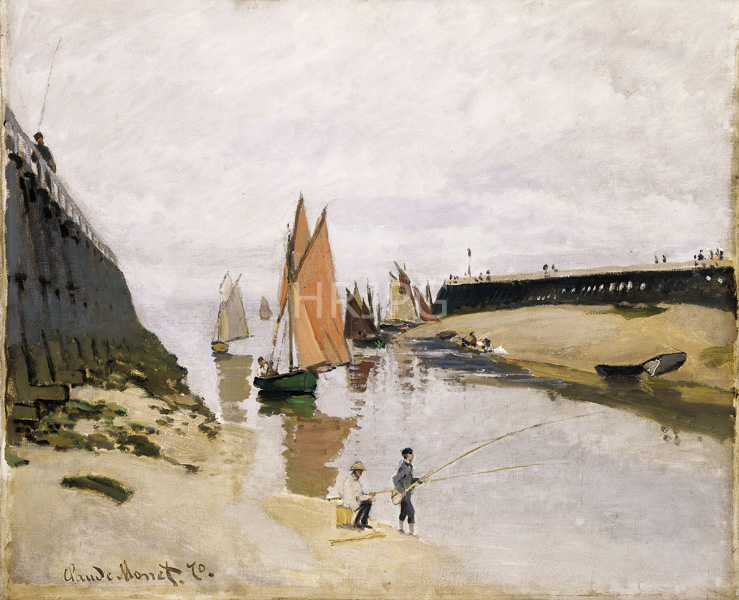
The visual center of the painting is the contrast between the dark, wooden hulls of the boats and the brilliant, shimmering surface of the water. Monet utilizes a palette of azure blues, soft grays, and warm ochres to represent the coastal environment. The sky is a masterclass in early atmospheric perspective, with layers of scudding clouds that suggest the moisture and movement of the maritime air. The boats provide a series of strong horizontal and vertical accents that anchor the composition, leading the eye toward the infinite horizon. He avoids hard outlines, relying instead on the vibration of tonal values to define the forms and the atmospheric 'envelope' of the salty air. The light is the primary actor, raking across the water and illuminating the white sails with a natural clarity that makes the scene feel fresh and immediate.
Technically, Entrance to the Port of Trouville showcases Monet’s early mastery of 'broken color' and his rejection of traditional chiaroscuro. He used a confident, impasto technique to build up the surface of the waves and the wooden hulls, giving the scene a tangible presence. He avoids traditional black even in the shadows, using deep blues and purples to maintain a consistent luminosity throughout. This focus on the optical truth of a single moment—the way the light catches the spray of the water—prefigures his lifelong obsession with 'instantaneity.' Historically, this work represents the peak of his early career, reflecting the stability and peace he found on the coast before the upheaval of the war.
Today, held in major collections such as the Museum of Fine Arts, Budapest, and the Musée d'Orsay, the painting is admired for its formal strength and its pioneering spirit. It remains a cornerstone of early Impressionism, illustrating the perfect union between the artist’s revolutionary eye and the maritime world he so passionately recorded. It is a timeless masterpiece that continues to inspire awe for its vibrant portrayal of a fleeting, sun-drenched moment on the French coast, marking the dawn of a new visual language that could accommodate the full complexity of the natural world through the lens of light.