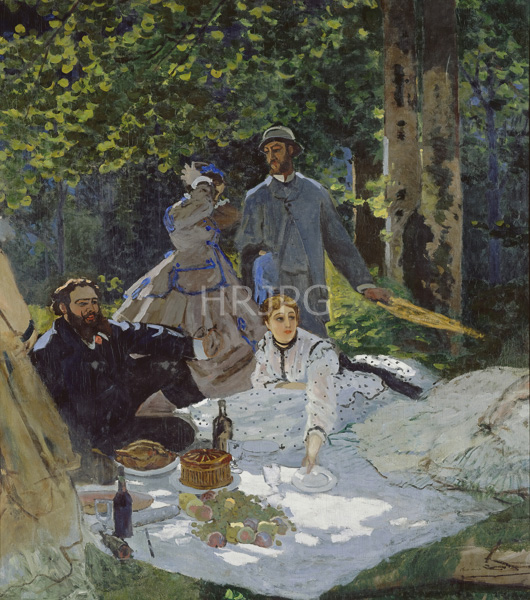
The visual logic of the fragments is defined by the extraordinary play of dappled sunlight filtering through the dense canopy of trees. Monet utilizes a palette of vibrant greens, soft ochres, and brilliant whites to represent the summer light. The figures are treated with a tactile weight, their fashionable garments serving as surfaces for the study of light and shadow. Unlike the static studio-bound portraits of the era, Monet’s picnickers are unified by the 'envelope' of warm air and the shifting patterns of the forest light. He avoids hard outlines, relying on the juxtaposition of tonal values to define the forms. The white tablecloth in the center acts as a primary stage for the study of reflection, catching the cool blue shadows and the warm glow of the sun.
Technically, Luncheon on the Grass showcases Monet’s early mastery of texture and his rejection of traditional chiaroscuro. He used a confident application of paint to build up the surface of the tree trunks and the foliage, giving the forest a tangible, sculptural presence. He avoids traditional black even in the deepest shadows, using deep blues and purples to maintain the painting's overall luminosity. This focus on the optical truth of a single moment—the way the sun catches the edges of a dress or a leaf—prefigures his lifelong obsession with 'instantaneity.' Historically, this work represents the foundation of Monet’s career and the birth of the Impressionist spirit, marking a radical break from historical narrative to find beauty in the 'heroism of modern life.'
Today, the surviving fragments are held in the Musée d'Orsay, where they are admired for their formal strength and their pioneering spirit. They remain a moving testament to Monet’s youthful ambition and his unrelenting commitment to recording the world exactly as he saw it. This work serves as a reminder that the Impressionist revolution began with a rigorous and honest observation of the physical world, and that for Monet, the natural light was the ultimate teacher. It is a masterpiece of early maturity that continues to inspire awe for its vibrant portrayal of a sun-drenched afternoon in the forest.