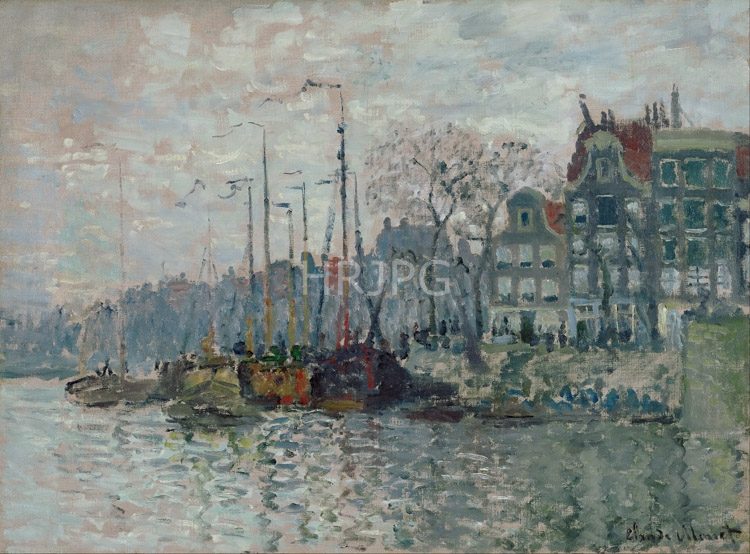
The visual center of the painting is the contrast between the rhythmic silhouettes of the Dutch houses and the fluid expanse of the water in the foreground. Monet utilizes a sophisticated palette of cool grays, deep indigos, and muted ochres to represent the Dutch atmosphere. The sky is a masterclass in tonal variation, with layers of soft clouds that diffuse the light across the harbor. The ships and their masts provide a series of vertical accents that cut across the horizontal planes of the quay and the horizon, creating a sense of dynamic movement and depth. He avoids hard outlines, relying on the juxtaposition of tonal values to define the forms and the atmospheric 'envelope' of the moisture-laden air.
Technically, View of the Prins Hendrikkade showcases Monet’s mastery of 'all-over' texture and the rejection of traditional perspective. He chose a vantage point that emphasizes the surface of the water, which acts as a liquid mirror reflecting the sky and the ships. The brushwork is varied and confident; he uses short, staccato marks for the architectural details and more fluid, horizontal strokes for the water. He avoids the use of black, using deep blues and purples in the shadows to maintain a high-keyed luminosity despite the overcast sky. This focus on the sensory 'impression' of the scene—the movement of the water and the vibration of the urban light—was a radical innovation in landscape painting.
Historically, the Amsterdam series proved to be a critical success for the young Monet, demonstrating that his Impressionist method was a universal language capable of handling any environment. These works reflect the artist's unrelenting curiosity and his desire to find new visual challenges. Today, held in major collections such as the Van Gogh Museum and the Metropolitan Museum of Art, the painting is admired for its freshness and its pioneering spirit. It serves as a vital document of Monet's early career, illustrating the bridge between his early outdoor observations and the visionary, light-obsessed series of his later years, reminding us that for him, the world was a continuous symphony of light and reflection.