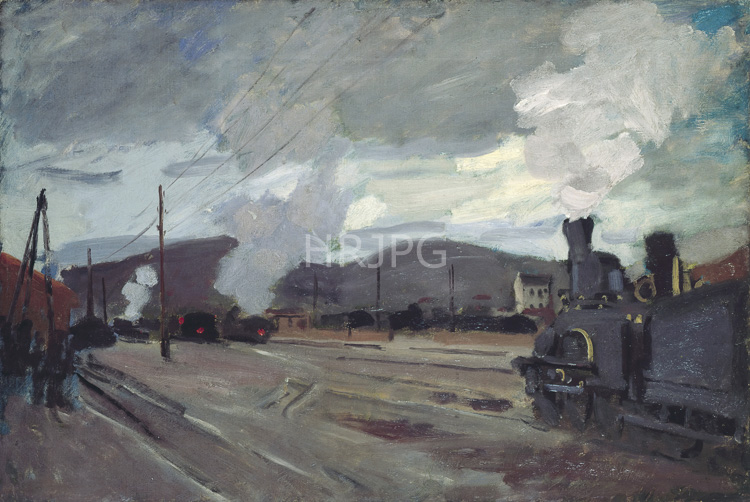
The visual logic of the painting is defined by the contrast between the rigid, geometric lines of the station's architecture and the fluid, ephemeral plumes of steam from the departing locomotives. Monet utilizes a palette of cool blues, soft grays, and warm ochres to represent the industrial environment. The station building provides a strong structural framework, while the steam acts as a luminous focal point that catches the soft sunlight. The tracks lead the viewer's eye into the depth of the composition, suggesting the reach and power of the new railway network. He avoids hard outlines, relying instead on the vibration of tonal values to define the forms and the movement of the air.
Technically, The Railway Station at Argenteuil showcases Monet’s early mastery of 'all-over' texture and his rejection of traditional perspective. He used a confident application of paint to build up the surface of the gravel and the steam, giving the scene a tangible presence. He avoids the use of black, using deep blues and purples in the shadows to maintain the painting's overall luminosity. This focus on the 'envelope' of light and air that unifies the industrial scene was a radical innovation, asserting that the engine of progress was as worthy of artistic attention as a floral garden.
Historically, this work reflects the rapid modernization of France under the Third Republic and the emergence of the railway as a central part of modern identity. It serves as an important precursor to his later and more famous Saint-Lazare Station series of 1877. Today, held in major collections such as the Musée d'Orsay, the painting is admired for its formal clarity and its visionary spirit. It remains a vital document of the 19th-century avant-garde, illustrating the moment when art broke away from naturalism to embrace the dynamic, fragmented reality of the industrial age, forever changing the course of landscape painting.