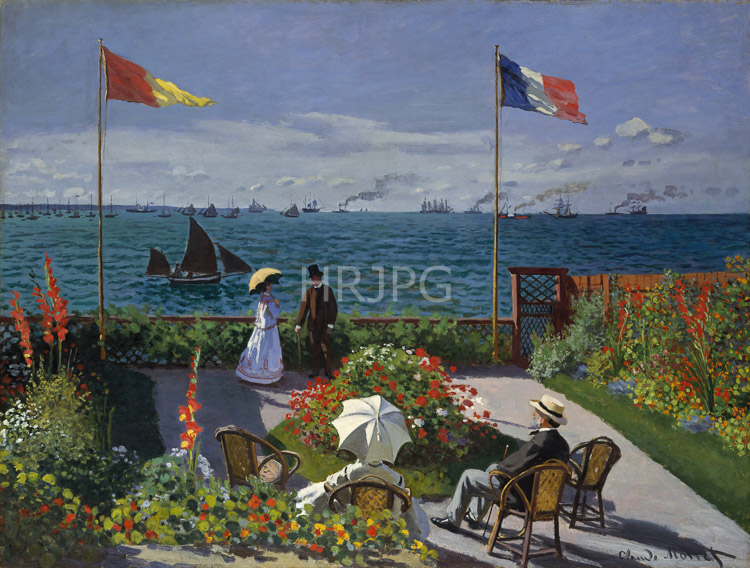
The visual center of the painting is the extraordinary contrast between the vibrant flowerbeds and the brilliant blue of the sea and sky. Monet utilizes a palette of saturated reds, yellows, and blues, creating a vibrating surface of color that mimics the intensity of the coastal sun. The composition is built on a series of horizontal and vertical planes—the terrace, the sea, and the horizon—which are punctuated by the vertical accents of the ship masts and the two flags fluttering in the breeze. The figures provide a crucial sense of scale and social reality, their dark silhouettes providing a structural counterpoint to the colorful blooms. The light is the primary actor, raking across the garden and illuminating the white sails on the horizon, creating a shimmering 'envelope' of air that makes the scene feel immediate and alive.
Technically, Garden at Sainte-Adresse showcases Monet’s move toward a more 'broken' and decorative style. While the figures and the flowers are more clearly defined than in his later works, one can already see the use of short, rhythmic dabs of color to represent the sensory 'impression' of a bloom. He avoids traditional black even in the shadows, using deep blues and purples to maintain a high-keyed luminosity. The sky is a masterclass in tonal variation, with layers of pale blue and soft clouds that suggest the moisture and movement of the maritime air. Historically, this work was a major professional achievement, demonstrating his ability to handle large-scale, complex outdoor compositions with a revolutionary eye. Today, held in the collection of the Metropolitan Museum of Art, it remains one of the most famous and significant works in art history, marking the moment when art broke away from description to embrace the vibrant, fragmented reality of light.