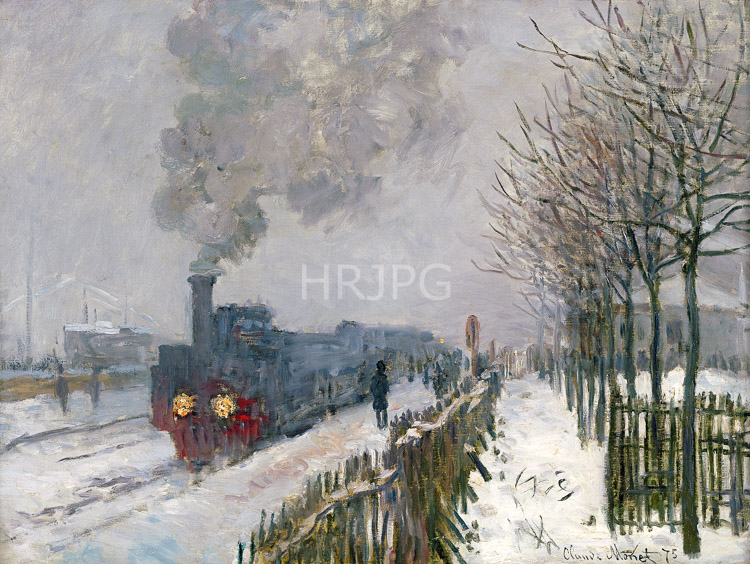
The visual center of the painting is the contrast between the dark, massive form of the locomotive and the brilliant, multifaceted 'white' of the surrounding snow. Monet utilizes a palette of cool blues, soft violets, and charcoal grays to represent the industrial 'envelope.' The steam is the primary actor in the scene, treated with the same lyrical intensity as the natural clouds. It acts as a bridge between the machine and the atmosphere, unifying the scene into a single field of light and motion. The snow is rendered with a sophisticated range of colors, demonstrating Monet’s principle that shadows in snow are filled with reflected light from the sky. The light is diffused and cold, suggesting a damp winter afternoon where the coal smoke and frost merge into a single, unified atmospheric effect.
Technically, Train in the Snow showcases Monet’s mastery of 'broken color' and his rejection of traditional detail. He used short, rhythmic brushstrokes for the steam and more textured, impasto marks for the snow-covered ground, giving the scene a tangible, sculptural quality. He avoids the use of black entirely, using deep indigos and purples in the shadows to maintain the painting's overall luminosity despite the industrial subject matter. Historically, this work reflects the rapid modernization of France and the emergence of the railway as a central part of modern identity. Today, held in major collections such as the Musée Marmottan Monet, the painting is admired for its formal clarity and its visionary spirit. It serves as an important precursor to his later Saint-Lazare Station series, illustrating the moment when art broke away from naturalism to embrace the dynamic, fragmented reality of the industrial age.