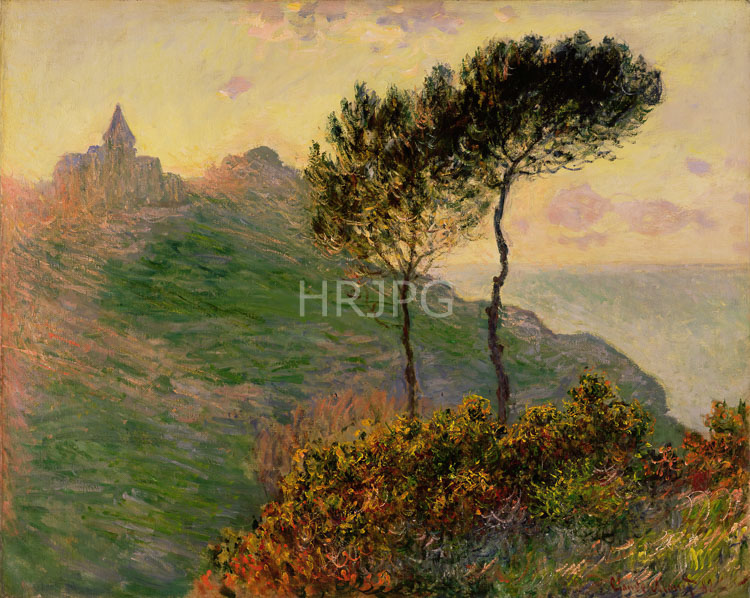
The visual logic of the painting is defined by the extraordinary contrast between the dark, silhouetted form of the church and the luminous, sun-drenched sky. Monet utilizes a sophisticated and restricted palette of warm ochres, deep violets, and pale pinks to represent the sunset light. The church, perched on the edge of the cliff, provides a rhythmic focal point that anchors the composition. The sky is a masterclass in tonal variation, where the light is so intense that it seems to radiate from within the canvas. The brushwork is exceptionally free and textured; he uses thick impasto for the highlights on the cliff and the sky, giving the scene a tangible, sculptural quality. He avoids hard outlines entirely, relying instead on the juxtaposition of different tonal values to define the forms and the immense depth of the coastal space, making the atmosphere feel as physical as the stone.
Technically, The Church at Varengeville showcases Monet’s mastery of 'all-over' texture and the rejection of traditional chiaroscuro. He avoids the use of black, using deep indigos and saturated purples in the shadows to maintain a high-keyed luminosity despite the silhouette effect. Historically, the Varengeville series was a major triumph for Monet, proving that the Impressionist method could be applied to architecture and light with profound success. Today, versions of this work are held in major collections such as the Barber Institute of Fine Arts and the Musée d'Orsay. It remains a cornerstone of modern art, illustrating the moment when art broke away from descriptive realism to embrace the visionary power of pure light. It serves as a reminder that for Monet, the act of seeing was a continuous adventure into the infinite complexities of the atmospheric world, turning a simple church into a monumental exploration of time and color.